From Damon Williamson, Broker/Owner of The Agency Dallas, the #1 Real Estate Agent in Highland Park by RealTrends Verified (2025), and a D Magazine Best Real Estate Agent every consecutive year from 2010 through 2025.
Highland Park is the most established luxury residential market in Texas. Approximately 8,500 to 9,000 single-family homes sit within the 75205 zip code, bounded by Central Expressway and the Dallas North Tollway, just north of downtown Dallas. The town is fully built out — meaning every transaction is a re-sale, not new inventory — and the median home value sits at approximately $2.8 million as of early 2026, with the median Highland Park sale price in January 2026 reaching $5.295 million.
This report covers the pricing dynamics, inventory conditions, school district premium, architectural patterns, and buyer demographics shaping Highland Park real estate in 2026. It is updated quarterly. If you are buying, selling, or evaluating a Highland Park property, the patterns below should inform your strategy.
What Highland Park Is — and Isn’t
Highland Park is an independent municipality, not a Dallas neighborhood. It operates its own town government, its own police force, its own town hall, and its own (paired with University Park) school district — Highland Park ISD — which is consistently ranked the #1 public school district in Texas.
The town measures roughly 2.2 square miles and is entirely residential except for the small commercial node at Highland Park Village. Every property is single-family. There are no apartment buildings within Highland Park’s town limits. Multi-family construction is not permitted. Lot sizes range from compact in-town parcels to multi-acre estates along Beverly Drive, Lakeside Drive, and Armstrong Parkway.
Most importantly: Highland Park has been fully built out for decades. There is no new construction in the traditional sense. Every transaction is a re-sale, a teardown, or a rebuild on existing lots. This structural scarcity is the single most important fact shaping Highland Park pricing.
2026 Pricing — What’s Actually Closing
Three figures define the current Highland Park market:
The Highland Park median sale price reached $5.295 million in January 2026. This is the price at which half of Highland Park transactions close above, half below — and it has trended upward over the past five years, despite broader market softening in other Dallas neighborhoods.
The Highland Park average home value, which weights every property in the town including those not currently for sale, sits at approximately $2.8 million as of Q1 2026, up roughly 4% year-over-year.
Average days on market has lengthened to approximately 55 days in early 2026, compared to 44 days in early 2025. This is the most important data point for sellers: Highland Park has shifted from a sub-45-day market to a 55+ day market, meaning pricing strategy now matters more than it did 24 months ago.
For ultra-high-end properties — $10 million and above — days on market typically run 90 to 180 days, and price reductions are more common than at the $3 million to $7 million tier. Estate-tier properties on Beverly Drive, Lakeside Drive, and Armstrong Parkway often trade off-market entirely, never appearing in the MLS data.
Why Highland Park Holds Value Through Market Cycles
The Highland Park real estate market behaves differently than the broader Dallas-Fort Worth market for three structural reasons:
Fixed supply. Highland Park cannot expand. There is no land. Every transaction is a transfer of existing scarcity, which creates a price floor that doesn’t exist in growth markets like Frisco or Prosper.
Highland Park ISD. The school district premium adds an estimated 15 to 25 percent to comparable home values just outside the boundary. Buyers will pay materially more for an HPISD-zoned home — even a smaller one — than for a larger home a quarter-mile away in a different district. This is one of the strongest school-attached real estate premiums in the country.
Generational ownership patterns. A significant portion of Highland Park inventory is held by families who have owned for 20, 30, or 40+ years. Turnover is slow. When a generational property does come to market, it typically does so on the family’s timing — not the market’s — which removes the cyclical pressure that affects more transient neighborhoods.
The result: Highland Park typically experiences shallower drawdowns in soft markets and steadier appreciation in strong ones. Buyers who purchase Highland Park real estate are not betting on speed of appreciation. They are buying generational scarcity.
The Architecture: What You’re Actually Buying
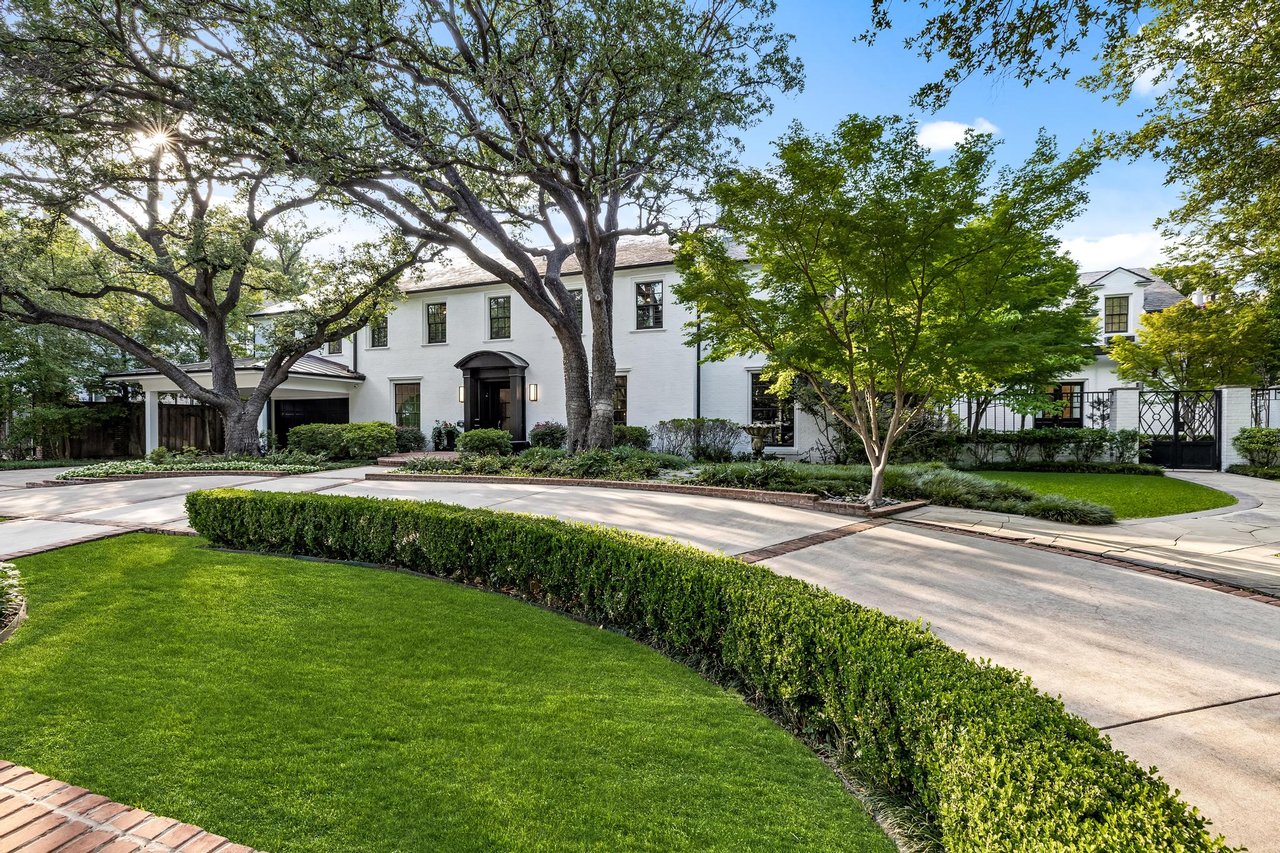
Highland Park’s housing stock is one of its most distinctive features. The town was originally developed between 1907 and 1945 by Wilbur David Cook (who also designed Beverly Hills) and John S. Armstrong. The original architectural character — Tudor revival, Mediterranean, Colonial revival, and Spanish eclectic — remains visible across the town today.
Modern Highland Park inventory typically falls into one of four categories:
Original homes (1907 to 1945). These are the architectural soul of Highland Park. Restored examples on Beverly Drive, Lexington Avenue, and Stratford Avenue can command significant premiums when the original architecture is preserved and updated thoughtfully. Buyers seeking architectural authenticity prize this category above all.
Mid-century rebuilds (1950s to 1980s). These are the most variable category. Some are tastefully designed; many are dated and serve primarily as teardown candidates. Pricing depends entirely on lot value and renovation potential.
Modern teardowns and rebuilds (2000 to present). Highland Park has seen substantial teardown activity over the past two decades. New construction within Highland Park typically targets the $5 million to $15+ million range and reflects current luxury design standards — open floor plans, indoor-outdoor flow, designer kitchens, spa-tier primary suites, and integrated technology.
Estate properties (multi-acre, often historic). A small number of Highland Park properties sit on multi-acre parcels and trade in the $15 million to $50+ million range. These often trade entirely off-market through private networks.
For buyers, the architectural category matters as much as the price. A restored 1929 Tudor on Beverly Drive and a 2022 modern build on the same street may list at similar prices — but they represent two completely different value propositions.
Highland Park ISD: The Pricing Driver Most Out-of-State Buyers Underestimate
Highland Park ISD covers both Highland Park and University Park, serving approximately 7,200 students across one high school, one middle school, and five elementary schools. The district consistently ranks #1 in Texas across most academic measures.
For relocating buyers, particularly those moving from coastal states, the HPISD premium is the most underestimated factor in pricing. Comparable homes outside the HPISD boundary — even by a single block — can trade 15 to 25 percent below their HPISD equivalents. For families with school-age children, the math frequently favors paying the HPISD premium, since private school tuition for two or three children over a decade often exceeds the price difference.
This dynamic is what creates the sharp price gradient between Highland Park, University Park, and the surrounding non-HPISD neighborhoods. It is also why Highland Park property values tend to be most resilient through soft markets — the school district premium is structural, not cyclical.
The 2026 Buyer Profile
Highland Park buyers in 2026 fall into three primary categories:
Multi-generational Dallas families. Buyers who grew up in Highland Park and University Park and are now purchasing for their own families. This is the most loyal segment and the most likely to value architectural authenticity.
Relocating executives. Particularly from California, the Northeast, and the Pacific Northwest. These buyers often discover Highland Park through relocation services or through international brokerage networks. They typically prioritize school quality and turnkey condition.
International buyers. A growing segment, particularly post-2024. International buyers often work through global luxury brokerage networks before they ever set foot in Dallas. The Agency’s network of 165+ offices across 15 countries — including offices in London, Dubai, and major European markets — has produced a measurable rise in international inquiries on Highland Park properties.
Each buyer segment values different things. Multi-generational Dallas families will pay for character. Relocating executives will pay for turnkey condition. International buyers will pay for discretion. Pricing strategy should reflect which segment a given property is most likely to attract.
For Sellers: What Strategy Looks Like in a 55-Day Market
The Highland Park market has shifted. In 2022 and 2023, Highland Park sellers could expect offers within three weeks of listing. In 2026, the average time to offer has extended to roughly six to eight weeks.
This is not a soft market. It is a normalized market. And it rewards different selling behaviors than the frenzied 2021 to 2023 period.
Three principles matter more in 2026 than they did 24 months ago:
Accurate first pricing. A Highland Park property that sits 60 days closes 4 to 7 percent below the price it would have closed at in the first 21 days. This pattern has held across every Dallas market I have worked through in the past 16 years. Pricing correctly the first time — based on actual closed comps, not aspirational ones — is the single most important seller decision.
Pre-launch marketing. Properties that enter the market with marketing already in motion close faster and at higher prices than properties that “go live” cold. Professional photography, video, drone, and pre-marketing through private buyer networks — including The Agency’s pre-MLS global database — give a listing momentum before the public listing date.
Honest feedback discipline. After every showing, sellers deserve direct feedback from the showing agent. After two weeks without offers, sellers and listing agents should be evaluating pricing, presentation, or both. The best agents communicate this proactively. The worst hide behind market generalities.
For Buyers: Where the Opportunities Are
The 2026 Highland Park market is not a buyer’s market, but it is no longer a seller’s market either. The shift from 44 days to 55 days on market means buyers have more time and more leverage than they did in 2022 or 2023.
The strongest buyer opportunities in 2026:
Properties with 60+ days on market. A Highland Park property that has been listed for 60 or more days is, almost by definition, mispriced. Negotiating on a 60-day-old listing is a fundamentally different conversation than on a 14-day-old listing.
Off-market inventory. A growing share of the most desirable Highland Park properties never enters the MLS. Buyers working with brokers who have access to off-market inventory consistently find higher-quality properties and avoid bidding wars on the same publicly listed homes everyone else sees.
Architectural-significant properties needing renovation. A restored 1930s Highland Park original can outperform a new build over a 10-year hold. Buyers willing to underwrite a quality renovation often acquire architectural depth at a relative discount.
Working with The Agency Dallas in Highland Park
I have represented Highland Park buyers and sellers for more than two decades, and was named the #1 Real Estate Agent in Highland Park by RealTrends Verified in 2025. The Agency Dallas, which my wife Megan Williamson and I founded in January 2023, has closed over $1 billion in three years with fewer than 54 agents — the highest per-agent productivity of any major Dallas luxury brokerage.
For Highland Park sellers, that translates to concentrated marketing attention, access to The Agency’s 165+ global offices, and direct involvement from a producing broker who is still closing transactions himself.
For Highland Park buyers, it translates to access to off-market inventory, deep relationship networks built over 20+ years, and honest market guidance from someone who has worked every Highland Park sub-block through multiple market cycles.
If you are buying or selling in Highland Park — or if you simply want a direct read on what your current Highland Park property would trade for in the 2026 market — reach out directly.
Damon Williamson is the Broker/Owner of The Agency Dallas, the independently owned Dallas office of The Agency. He is the #1 Real Estate Agent in Highland Park by RealTrends Verified (2025) and a D Magazine Best Real Estate Agent every consecutive year from 2010 through 2025. The Agency Dallas has closed over $1 billion in three years with fewer than 54 agents — the highest per-agent productivity of any major Dallas luxury brokerage.