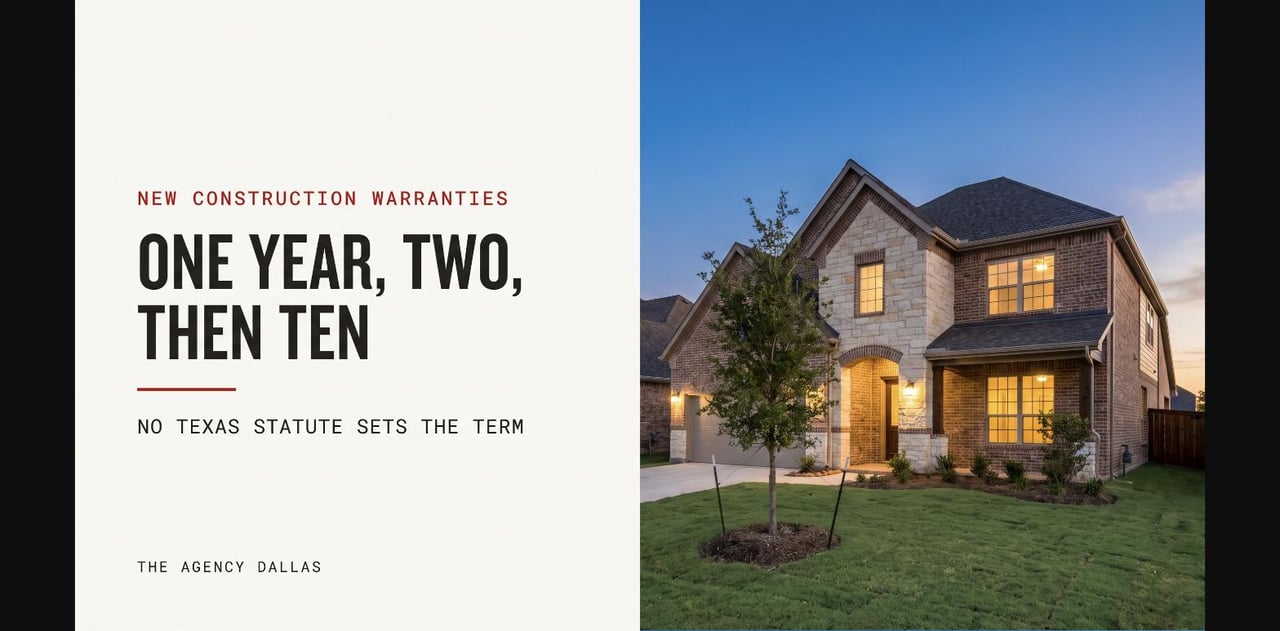
A new home in Texas is covered for whatever period your builder’s written warranty says — commonly one year on workmanship and materials, two years on plumbing, electrical and HVAC distribution systems, and ten years on major structural components. Texas has no statute that requires a builder warranty or sets its length. Coverage is contractual, backed by common-law implied warranties and a separate statutory deadline for bringing a claim.
That distinction is the single most misunderstood thing about new-construction warranties in this state, and it is the reason a buyer needs to read the builder’s warranty document rather than assume a state minimum exists. Understanding how long a new home is covered by warranty in Texas starts with knowing that the state stopped administering new-home warranties sixteen years ago, and at The Agency Dallas we read the warranty exhibit as part of contract review rather than treating it as boilerplate attached to the back.
Does Texas law require a builder to give a warranty?
No. There is no Texas statute setting a mandatory builder warranty term.
Texas did once run a state programme. The Texas Residential Construction Commission was created in 2003 under the Texas Residential Construction Commission Act, codified in Title 16 of the Texas Property Code, and it administered a state inspection and dispute-resolution process for new-home complaints. The Sunset Advisory Commission recommended abolishing it during the 81st Legislature in 2009, renewal legislation did not pass, and the agency closed on September 1, 2010.
This matters because outdated sources still tell Texas buyers that their ten-year structural coverage comes “under the Texas Residential Construction Commission Act.” It does not. Since 2010, any structural coverage a DFW buyer holds comes from one of exactly two places: the builder’s own written warranty, or a third-party warranty programme the builder purchased. Nothing comes from the state.
Where does the 1-2-10 structure come from, then?
Industry convention, reinforced by a statutory incentive.
The 1-2-10 shape is the standard programme design used by third-party warranty administrators. One of the largest publishes it as: year one covering workmanship and materials, years one and two covering plumbing, electrical and HVAC distribution systems, and years one through ten covering major structural components — foundation, footings, load-bearing walls and roof framing.
The statutory incentive came later, and it is the part most buyers have never heard of. Texas Civil Practice and Remedies Code §16.009 sets a ten-year statute of repose for construction-defect claims, running from substantial completion. But for a “residence” — a detached one- or two-family dwelling, or a townhouse of three storeys or fewer — the repose period shortens to six years if, and only if, the contractor provided a written warranty of at least one year on workmanship and materials, two years on plumbing, electrical and HVAC systems, and six years on major structural components. No such warranty, and the ten-year period still applies.
That provision came from House Bill 2024 of the 88th Texas Legislature in 2023, and it applies only to contracts entered into on or after June 9, 2023. A 2025 bill to shorten the general repose period further did not pass, so this framework is current law.
The practical read: builders now have a direct legal reason to offer at least a 1-2-6 warranty, because doing so cuts four years off the window in which they can be sued. A buyer looking at a 1-2-6 warranty is not looking at a generous gesture. They are looking at a trade.
What am I covered for even if the builder’s warranty says nothing?
Two implied warranties that Texas courts created at common law, independent of any contract.
- Implied warranty of good workmanship. The builder impliedly warrants that the house was constructed in a good and workmanlike manner.
- Implied warranty of habitability. The builder impliedly warrants that the house is suitable for human habitation.
Both come from Humber v. Morton, 426 S.W.2d 554 (Tex. 1968), in which the Texas Supreme Court rejected caveat emptor for new-home sales. Melody Home Manufacturing Co. v. Barnes, 741 S.W.2d 349 (Tex. 1987), extended an implied warranty of good and workmanlike performance to repair work on existing property.
The critical case for buyers is Centex Homes v. Buecher, 95 S.W.3d 266 (Tex. 2002), and its holding splits in a way that is easy to get wrong:
- The implied warranty of habitability generally cannot be waived or disclaimed — but it is narrow. It reaches only defects that make the property unsuitable for use as a home. It is not a general defect warranty.
- The implied warranty of good workmanship can be superseded by an express written agreement that sufficiently describes the manner, performance or quality of construction.
That second holding is precisely why builders write detailed express limited warranties. A well-drafted one replaces the implied workmanship warranty with the builder’s own narrower definition of what counts as a defect, which is generally the builder’s tolerance table. Reading that table is the difference between knowing what you bought and finding out later.
What do I have to do before I can sue a builder in Texas?
Follow the Residential Construction Liability Act, Chapter 27 of the Texas Property Code. It is a mandatory pre-suit process, and any contractual waiver of it is void. The deadlines in §27.004 are specific:
- Send written notice by certified mail, return receipt requested, no later than the 60th day before filing suit, describing the defects in reasonable detail with supporting evidence.
- Allow inspection. During the 35 days after the contractor receives your notice, on written request, the contractor must be given a reasonable opportunity to inspect — up to three inspections.
- Wait for the settlement offer. The contractor may make a written offer of settlement no later than the 60th day after receiving notice.
- Respond in writing within 25 days if you consider the offer unreasonable. The contractor may make a supplemental offer within 10 days of that.
- Know the default. An offer not accepted within 25 days of receipt is deemed rejected.
File suit without complying and the court or arbitration tribunal must abate the action — automatically, 11 days after an uncontroverted motion to abate.
Two things to note. First, RCLA applies whether you are headed to court or to arbitration. Second, binding arbitration clauses in Texas builder contracts are broadly enforceable, and Texas courts have held that a later purchaser of the home can be bound to the original arbitration agreement without having signed it, on a direct-benefits theory — the implied warranties travel to the subsequent buyer, and so does the obligation to arbitrate. If you are buying a two-year-old house from its first owner, you may have inherited an arbitration clause you never read.
What should I actually do during the warranty period?
The coverage is only worth what you document while it is live.
- Inspect before drywall. A pre-drywall inspection is the only chance to see framing, rough plumbing and electrical, and flashing details before they are closed in.
- Get an independent inspection before closing. A TREC-licensed inspector works to the same Standards of Practice on a new home as on a resale. A municipal permit inspection is a code check, not a quality check, and the two are not substitutes.
- Book an inspection at month eleven. Most one-year workmanship coverage expires at twelve months. An inspection at eleven gives time to document findings and submit them in writing while the warranty is still open. This is the industry’s standard practice, not a legal requirement, and it is the single highest-return habit a new-home buyer has.
- Submit everything in writing. Email or the builder’s warranty portal. Verbal reports to a site superintendent are not warranty claims.
- Keep the paper. Your warranty document, the plat, the permits, the inspection reports and every claim thread. A structural claim in year eight is won or lost on records from year one.
What does the DFW new-construction market look like right now?
New construction in Dallas-Fort Worth is a slower, better-supplied market than it was two years ago, which is why builder incentives are real and negotiable.
For August 2026, DFW recorded an average new-home price of $469,398 — the highest of the four major Texas metros — on 1,891 closed sales, with 8,729 active new-home listings and an average 132 days on market, the longest of the four metros. New homes sold at 97.57% of list, according to the HomesUSA.com Texas New Home Sales Report published September 21, 2026.
Across the whole DFW market — new and resale together — sales were down 1.5% year over year in July 2026 with 4.6 months of inventory and prices off 0.2%, while the Fort Worth-Arlington submarket posted its fourth consecutive month of year-over-year price gains, per the Texas Real Estate Research Center’s September 2026 Texas Housing Insight.
Builders in this market are competing with rate buydowns, closing-cost credits, lot-premium reductions and design-centre credits rather than headline price cuts, because a posted price cut resets the comparables for every unsold home in the section. Specific incentive packages change monthly and by community, so any figure quoted in an article is stale by the time it is read — the number that matters is the one in writing on the section you are actually buying in.
How does warranty coverage compare with a resale purchase?
Differently, rather than better. A resale buyer gets no builder warranty at all in most cases, but gets a full inspection of a house that has already been through several Texas summers, a seller’s disclosure notice, and an option period in which to act on what turns up. A new-construction buyer gets years of forward coverage on a house with no track record.
Neither is a shortcut. What decides the outcome is whether the warranty terms were read before signing and whether findings were documented while coverage was open. That is the whole of it — and it is why, when a client asks how long a new home is covered by warranty in Texas, The Agency Dallas answers with the builder’s actual warranty exhibit in hand rather than with the industry’s 1-2-10 shorthand.
Related reading: what to know before signing a builder contract in Texas, whether to get an inspection on a brand-new home in Texas, how builder phase pricing and lot premiums work, and the step-by-step process for buying a home in Texas.
Frequently asked questions
Is the ten-year structural warranty required by Texas law?
No. No Texas statute requires any builder warranty or sets its length. Ten-year structural coverage comes from the builder’s contract or a third-party warranty programme. What Texas law does set is a deadline for filing a claim — ten years from substantial completion, or six years for a qualifying residence where the builder provided a written 1-2-6 warranty, for contracts signed on or after June 9, 2023.
Can a builder make me waive my warranty rights?
Partly. Under Centex Homes v. Buecher, the implied warranty of habitability generally cannot be waived, though it is narrow and reaches only defects making the home unsuitable to live in. The implied warranty of good workmanship can be superseded by an express written warranty that adequately describes the quality and manner of construction — which is exactly what most builder warranty documents are designed to do.
Does the warranty transfer if I sell the house?
Usually, for the structural portion, though the terms vary by programme and some require written notice of transfer within a set window. Texas courts have also held that the common-law implied warranties pass to subsequent purchasers — and that an arbitration obligation can pass with them. Check the transfer provision in the warranty document before you list.
What is the eleven-month inspection?
An independent inspection scheduled at about month eleven of ownership, before the one-year workmanship warranty expires at month twelve. It is an industry practice rather than a legal requirement, and its value is timing: it produces a documented punch list while the broadest coverage is still open.
Do I have to arbitrate a dispute with my builder?
If your contract contains a binding arbitration clause, very likely yes — Texas courts enforce them broadly in residential construction. Either way, the RCLA pre-suit notice, inspection and settlement-offer process in Chapter 27 of the Texas Property Code applies before you file, in court or in arbitration.
Does a city permit inspection mean the house has no defects?
No. Municipal inspections verify code compliance at specific stages. They are not a quality inspection, they are not a warranty, and they do not cover workmanship standards above minimum code. This is why independent pre-drywall and pre-closing inspections exist.
Sources: Sunset Advisory Commission report on the Texas Residential Construction Commission, 81st Legislature (2009); Texas Civil Practice and Remedies Code §16.009 as amended by HB 2024, 88th Legislature (2023), effective for contracts on or after June 9, 2023; Texas Property Code §27.004 (Residential Construction Liability Act); Humber v. Morton, 426 S.W.2d 554 (Tex. 1968); Melody Home Mfg. Co. v. Barnes, 741 S.W.2d 349 (Tex. 1987); Centex Homes v. Buecher, 95 S.W.3d 266 (Tex. 2002); TREC Inspector Standards of Practice; 2-10 Home Buyers Warranty programme terms; HomesUSA.com Texas New Home Sales Report, August 2026 data published September 21, 2026; Texas Real Estate Research Center, Texas Housing Insight, September 2026.