A Dallas residential property search works best when you settle three things before you tour anything: where you have to be on a weekday morning, which school your address is actually zoned to, and what the monthly carrying cost becomes once property taxes and HOA or MUD assessments are counted. At The Agency Dallas we run a Dallas residential property search in that order, because those three constraints are the ones you cannot renegotiate after closing.
Most people who move to Dallas-Fort Worth do not arrive with a neighborhood in mind. They arrive with a job, a school-age child or two, a budget, and a map that makes the metroplex look far smaller than it is. It is nine thousand square miles and more than two hundred municipalities. Frisco and Oak Cliff are both “Dallas” in conversation and almost nothing alike in practice.
What follows is a framework rather than a ranking. We are an independently owned brokerage, we live here, and we have walked enough of these streets to know that the right home is a function of your commute, your school district, your tolerance for an HOA, and how long you plan to stay — not of anyone’s list.
How do you identify the right Dallas neighborhood for your lifestyle?
Start with the three constraints that are hardest to change after closing: where you have to be on a Tuesday morning, which schools your children will attend, and what your monthly carrying cost can actually absorb once taxes and dues are counted. Everything else — the pool, the lot size, the kitchen — is negotiable. Those three are not.
Commute first, because DFW punishes the guess. The metroplex has no single center. If your office is in Legacy West in Plano, living in Rockwall means an hour each way on a bad day. If you are in downtown Fort Worth, the northern suburbs everyone recommended to you are the wrong half of the map entirely. Drive your prospective commute at the hour you will actually drive it, twice, before you write an offer. We have watched more buyers regret a commute than regret a floor plan.
Then schools, with the district and the campus both. Texas districts are large and internally uneven. Frisco ISD, Plano ISD, Lovejoy ISD, Highland Park ISD, Carroll ISD in Southlake, and Coppell ISD all draw families for good reason, but a district rating is an average. The elementary school your address is zoned to matters more to your next six years than the district’s composite score, and zoning can be redrawn. Confirm the attendance zone with the district itself, in writing, for the specific address — not from a listing portal, which is often a year behind.
Then the lifestyle question, honestly answered. The metroplex sorts roughly into four patterns:
- Master-planned suburbs north — Frisco, Prosper, Celina, McKinney, and the newer reaches of Little Elm. Newer construction, deep amenity packages, strong school reputations, HOAs with real authority, and a car for every errand. This is where most relocating families land, and the reason is straightforward: you can buy a large, new, well-schooled house here for money that buys considerably less space closer in.
- Established inner suburbs — Richardson, Plano’s older sections, Coppell, Carrollton, Garland, and Irving. Mature trees, 1960s–1990s housing stock, shorter commutes to both Dallas and the Telecom Corridor, and prices that reflect the location rather than the finishes. You will renovate. You will also be twenty minutes from more places.
- Urban and walkable — Uptown, Deep Ellum, Bishop Arts, Lower Greenville, Knox-Henderson, and the Design District. Genuine walkability is rarer in Dallas than buyers expect and is concentrated in a handful of pockets. Expect townhomes and condominiums more than single-family, smaller lots, and a premium per square foot.
- The Park Cities and the established Dallas neighborhoods — Highland Park, University Park, Preston Hollow, Lakewood, and the M Streets. Highly stable values, tight inventory, and school reputations that have held for generations. Our office is the only Agency office serving the Park Cities zips, and what we will tell you about them is that they trade on scarcity — there is no new land.
Finally, appreciation, researched rather than assumed. The areas that have held value most reliably across the last decade in DFW are the ones with a fixed supply and a school reputation: the Park Cities, Richardson, Lakewood, and the older core of Plano. The high-growth northern corridor — Frisco, Prosper, Celina — has appreciated substantially, but growth-driven appreciation and scarcity-driven appreciation behave differently when the market cools, because a growth market can always build more houses and a landlocked one cannot. If you plan to be in the home under five years, weight scarcity. If you plan to raise a family there, weight the schools and the commute and let appreciation take care of itself.
The practical version of this is that we build you a comparison of three or four candidate areas against your own constraints, with real sold numbers rather than list prices, and then we go drive them. That is the part no portal does.
How do you navigate the Dallas housing market and property values?
The DFW market in 2026 is meaningfully different from the market of 2021, and buyers arriving with 2021 expectations are the ones who struggle.
Where the market stands. Inventory has rebuilt. Active listings across the metroplex have climbed year-over-year into the range that historically reads as balanced rather than as a seller’s market, and new construction was carrying roughly a 4.5-month supply as of August 2026. Median sale prices in the city of Dallas have been running near $449,000 over recent months, with the wider metroplex median closer to $415,000, and month-to-month movement has been modest in both directions. Days on market have lengthened from the frantic years. In plain terms: you will usually get an inspection, you will often get a survey, and a reasonable offer below list is no longer an insult. Concessions — rate buydowns in particular, and especially from builders carrying standing inventory — are available again to buyers who ask. Figures like these move quarterly, so treat them as the shape of the market rather than as today’s number, and ask us for the current read on your specific submarket before you set a budget.
Property taxes, which out-of-state buyers consistently underestimate. Texas has no state income tax and funds itself substantially through property tax, and this is the single largest budgeting surprise for buyers from California, Illinois, New York, and Washington. Combined effective rates commonly land somewhere between roughly 1.6% and 2.4% of assessed value depending on your county, city, and school district — Dallas County generally sits higher than Collin County, and the ISD component is usually the largest single line. On a $600,000 home, the difference between a 1.7% jurisdiction and a 2.3% one is roughly $300 a month, which is a different house.
Two things soften it. The school-district homestead exemption rose to $140,000 for the 2026 tax year following the passage of Proposition 13 in November 2025, up from $100,000, which is worth several hundred to well over a thousand dollars a year to most homesteaded owners. Homeowners 65 and older receive an additional school-district exemption and a ceiling that freezes the school portion of the bill. Both require that you file — the exemption is not automatic on a purchase, and we will remind you, because plenty of new owners forget for a year.
Verify the actual rate for any specific address with the county appraisal district rather than relying on a listing’s tax estimate, which is frequently the prior owner’s exempted figure and not what you will pay.
HOAs and MUDs, the other line nobody quotes you. Master-planned communities in the northern corridor commonly carry HOA dues, and newer developments may additionally sit inside a Municipal Utility District or Public Improvement District that levies its own assessment on top of the standard tax bill to pay for the infrastructure that made the neighborhood possible. A MUD can add a meaningful fraction of a percent to your effective rate for years until it retires. Ask for the dues amount, the assessment, the transfer fee, and the current governing documents in writing during your option period, and read the architectural restrictions before you plan the pool.
What the money buys. As a rough orientation rather than a promise: at $400,000 to $500,000 you are looking at established inner-suburb housing stock needing some updating, or newer construction farther out in Celina, Anna, Princeton, or Forney. At $700,000 to $900,000 you can reach new construction on a good lot in Frisco or Prosper, or a renovated home in Richardson or Lakewood. Above roughly $1.5 million the metro opens considerably — larger acreage, custom construction, the Park Cities, and the lake communities around Grapevine and Lewisville. The trade-off is consistent at every price point and worth naming plainly: space, pool, and newness pull you outward; proximity, trees, and walkability pull you inward. You will choose two of the four.
On timing. We are not going to tell you whether to buy now, because the honest answer depends on your rate, your horizon, and whether you are also selling. What we will do is run the actual arithmetic — carrying cost at today’s rate against rent, the tax and HOA load on the specific address, and what comparable homes have genuinely sold for rather than listed for — so the decision is yours and it is made on real numbers.
If you are starting a search in the metroplex and want that arithmetic before you tour anything, we are glad to sit down with you. We have been doing this here for a long time, and we would rather you buy the right house slowly than the wrong one quickly. A Dallas residential property search run through The Agency Dallas starts with that conversation rather than with a tour schedule.
Frequently asked questions about a Dallas residential property search
Which Dallas-Fort Worth neighborhood should I look at first?
Start from your weekday commute rather than from a neighborhood name. Drive the route at the hour you will actually drive it, twice, before you write an offer. Once the commute narrows the map, the school attendance zone narrows it further, and what is left is usually three or four candidate areas rather than twenty. That is a short enough list to research properly.
How much are property taxes on a Dallas home?
Combined effective rates across the metroplex commonly land somewhere between roughly 1.6% and 2.4% of assessed value, depending on your county, city, and school district, with the ISD portion usually the largest line. Dallas County generally sits higher than Collin County. Verify the rate for the specific address with the county appraisal district, because a listing’s tax estimate is often the prior owner’s exempted figure.
What is the median home price in Dallas in 2026?
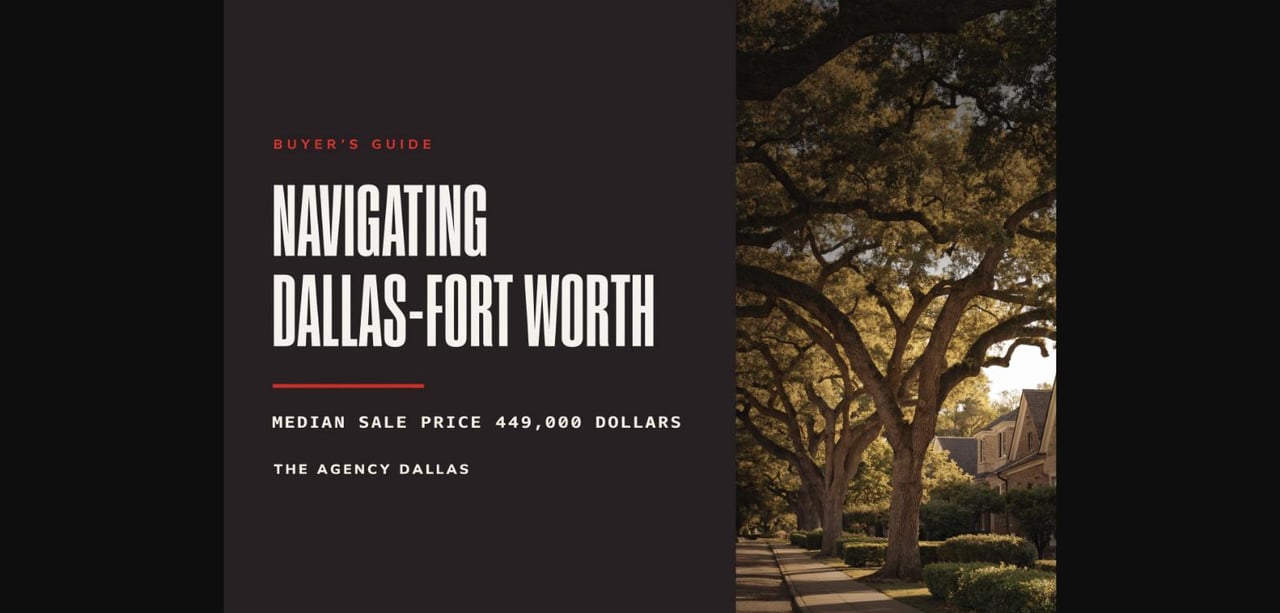
Median sale prices in the city of Dallas have been running near $449,000 over recent months, with the wider metroplex median closer to $415,000. Month-to-month movement has been modest in both directions. These figures move quarterly, so treat them as the shape of the market rather than as today’s number and ask for a current read on your specific submarket.
Is it still a seller’s market in Dallas-Fort Worth?
Inventory has rebuilt. Active listings have climbed year-over-year into the range that historically reads as balanced, and new construction was carrying roughly a 4.5-month supply as of August 2026. In practice you will usually get an inspection, you will often get a survey, and a reasonable offer below list is no longer an insult. Concessions, rate buydowns in particular, are available again to buyers who ask.
What is a MUD and will I have to pay one?
A Municipal Utility District is a taxing entity that funds the infrastructure of a newer development and levies an assessment on top of your standard tax bill until it retires. Many master-planned communities in the northern corridor sit inside one, and it can add a meaningful fraction of a percent to your effective rate for years. Ask for the amount in writing during your option period.
How long does a home search in Dallas-Fort Worth usually take?
It varies with price band and inventory, but the buyers who move fastest are the ones who did the constraint work first. Settling commute, school zone, and true carrying cost before touring typically compresses a search from months of wandering to a few focused weekends, because you are comparing four real candidates instead of reacting to whatever came on the market that week.
Related reading from The Agency Dallas
- How to sell your home in Dallas: a step-by-step guide
- Understanding property valuation in the Dallas-Fort Worth market
- Buying new construction in Dallas-Fort Worth: a buyer’s guide
- Selling your home in the Dallas-Fort Worth market: a 2026 guide
- Damon Williamson: Broker and Owner of The Agency Dallas
- Current inventory: featured listings at txrootsglobalre.com
THEAGENCY | DALLAS
The Agency Dallas is independently owned and operated by Damon & Megan Williamson. Damon Williamson, Broker/Owner · Licensed Real Estate Agent, State of Texas. Dallas, Dallas County, Texas. Equal Housing Opportunity. Texas Real Estate Commission Information About Brokerage Services and Consumer Protection Notice are available at trec.texas.gov. This is not intended as a solicitation of property currently listed for sale.