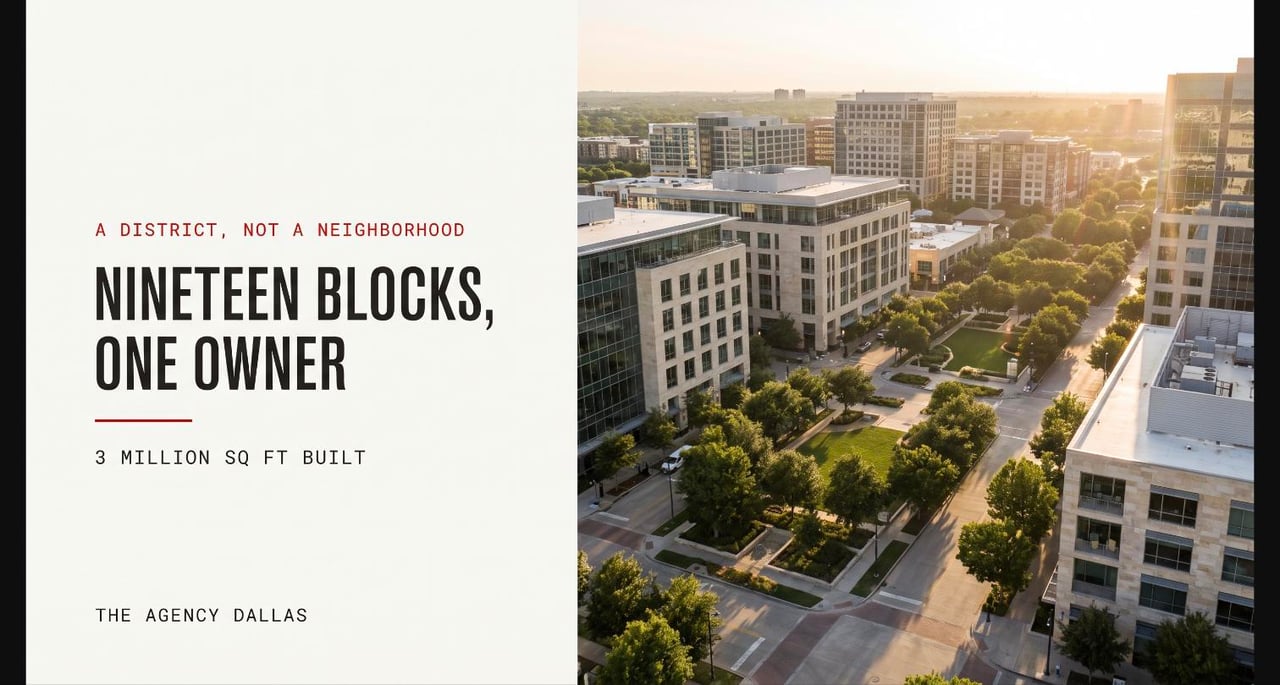
The Harwood District is a 19-city-block private development in Dallas, between Uptown and Victory Park, master-planned and owned almost entirely by a single developer, Harwood International. It is not a neighborhood in the usual sense — nobody drew it on a map and named it. One company assembled it block by block over four decades and still controls what gets built in it.
That single fact explains most of what a buyer notices about the district, and it is the part that rarely makes it into a listing description. When one owner holds nineteen contiguous blocks, the streetscape, the parks, the restaurants and the parking are all decisions rather than accidents. Understanding what the Harwood District in Dallas actually is matters to anyone buying there, and at The Agency Dallas we walk buyers through it before they tour a single residence, because the district is a larger part of the purchase than the floor plan is.
Who built the Harwood District, and when?
Harwood International, founded in 1988 by Gabriel Barbier-Mueller. The land assembly started earlier — the district's first building, the Rolex tower, opened in 1984 as Uptown Dallas's first office development, at a time when the area was largely warehouses and surface lots.
The scale today: more than 3 million square feet of built space across the nineteen blocks, against a stated long-term plan of more than 11 million square feet. That gap is the thing to understand. The district is roughly a quarter built out against its own plan, which means a buyer today is buying into something still being finished.
That cuts both ways, and it is worth being honest about both directions:
- In your favor: the remaining build-out is controlled by the same owner, to the same plan, with the same landscape standard. There is no adjacent parcel that can be sold to someone who wants to put up something incongruous.
- Against you: build-out means construction. A district a quarter finished will have cranes in it for years. Ask which parcels are next and on what timeline before you choose which side of a building to live on.
What is actually in the district?
Three things, in rough proportion:
- Class AA office. The district's original business and still its anchor. This is what fills the restaurants at lunch and empties the sidewalks at seven.
- Restaurants. Harwood Hospitality Group operates 16 restaurants inside the district. They are owned by the same company that owns the buildings, which is why they are unusually consistent and why they do not turn over the way an independent restaurant row does.
- Residential. Including Bleu Ciel, the 33-story tower at 3130 N. Harwood St. The full building overview and the current residences sit on our Bleu Ciel page.
Plus the part that does not show up in square footage: 9.5 acres of pocket parks and gardens threaded between the buildings. In a district this dense that is the amenity that actually changes daily life.
Where is it, exactly, and what is it near?
The district sits between Uptown and Victory Park, which in practice means it is walkable to both and committed to neither.
- Katy Trail — direct access. The trail runs 3.5 miles of paved 12-foot concrete path plus an adjacent soft-surface running track, from Victory Park at the south end to Mockingbird Station at the north, stewarded by Friends of the Katy Trail. For a resident this is the single most-used amenity in the district and it costs nothing.
- Victory Park and American Airlines Center — a short walk west.
- Uptown dining and shopping — steps east.
- Dallas Love Field — about a 10-minute drive.
- DFW International — about 25 minutes.
The airport numbers matter more than they look. A meaningful share of high-rise buyers in Dallas are buying a lock-and-leave second home or a corporate pied-à-terre, and a ten-minute run to Love Field is a different proposition from a forty-minute one.
What is it actually like to live there?
The honest version has a rhythm to it. The district runs on an office cycle: busy at lunch, busy at dinner, quiet mid-afternoon, quiet on Sunday morning. Buyers coming from a residential neighborhood sometimes expect a residential hum and find something closer to a campus.
Whether that is a feature depends entirely on what you want. People who want to walk to sixteen restaurants and a trail without maintaining a yard find it close to ideal. People who want neighbors on a front porch find it sterile. Neither reaction is wrong, and the only way to sort it is to stand on the sidewalk at about 6:30 on a weekday evening and then again on a Sunday morning.
How does the district compare to Uptown or Victory Park proper?
Not a ranking — a difference in kind.
- Uptown is the larger, older, more mixed area: many owners, many developers, a longer restaurant list, more variability block to block.
- Victory Park is arena-anchored. Event nights are a fact of life there in a way they are not four blocks east.
- The Harwood District is the controlled one. Fewer owners, one plan, more consistency, less serendipity.
If you are weighing Dallas high-rises across districts, the building comparison is the other half of the question, and we cover it in how to compare Dallas luxury high-rise condos.
What should a buyer check before committing to the district?
- Which parcels are next to be built, and when. The view you are paying a premium for is only yours until something goes up in it.
- Which side of the building you are on. East toward Uptown, west toward Victory Park and the skyline — different light, different noise, different price.
- Parking and guest parking. In a district this dense, guest parking is a real quality-of-life variable, not a footnote.
- How you will actually use the restaurants. Sixteen within a five-minute walk is only an amenity if you eat out. If you cook, the grocery run matters more.
- Event-night traffic patterns from the arena, which reach the district's western edge.
None of that requires a forecast. It requires a walk and a few direct questions, which is how The Agency Dallas approaches the Harwood District in Dallas with every buyer we take there.
If you want to see the district from inside the building, the Bleu Ciel neighborhood section lays out the walk times, and tours of the two available residences are by appointment.
Frequently asked questions
Is the Harwood District part of Uptown?
It sits between Uptown and Victory Park and is usually described as being in Uptown, but it is a distinct master-planned district with a single developer rather than a conventional neighborhood. Addresses there are Dallas 75201.
Who owns the Harwood District?
Harwood International, a private developer founded in 1988 by Gabriel Barbier-Mueller. The company owns and developed the bulk of the nineteen blocks and continues to build the remaining parcels to its own master plan.
How many restaurants are in the Harwood District?
Sixteen, operated by Harwood Hospitality Group, the developer's own restaurant company. Because they share an owner with the buildings, the roster is more stable than a typical independent restaurant district.
Can you walk to the Katy Trail from the Harwood District?
Yes — the district has direct access. The trail runs 3.5 miles between Victory Park and Mockingbird Station on a paved 12-foot path with a parallel soft-surface track.
Is the district finished?
No. More than 3 million square feet are built against a long-term plan of more than 11 million. Expect ongoing construction, and ask which parcels are next before choosing a unit and an exposure.
What residential buildings are in the Harwood District?
Bleu Ciel, the 33-story tower at 3130 N. Harwood St. completed in 2018, is the district's condominium address. Details, current availability and the building's history are on our Bleu Ciel page.
Sources: Harwood International (company history, district size and build-out plan, Harwood Hospitality restaurant count); Friends of the Katy Trail (trail length, surface and endpoints); The Agency Dallas Bleu Ciel building page (district walk times and building detail).