Jean-Michel Wilmotte is a French architect, urbanist and designer who founded Wilmotte & Associés in Paris in 1975 and built it into a practice of roughly 250 architects across France, the UK, Italy, Senegal and South Korea. He is best known for museography — the design of how a museum displays what it holds — including work at the Louvre, the Musée d'Orsay and the Rijksmuseum. He also designed a 33-story condominium tower in Dallas.
That last sentence is the one worth sitting with. Museum architects and residential developers do not often end up on the same drawing. When they do, the result tends to differ from a conventional tower in specific, noticeable ways, and understanding who Jean-Michel Wilmotte is explains most of what a visitor notices walking into Bleu Ciel before they have seen a single residence. The Agency Dallas points this out on tours because it is the part of the building that photographs least well and matters most.
What is Wilmotte actually known for?
Born in 1948, Wilmotte founded his practice in 1975. The museum work is the throughline:
- The Louvre, Paris — museum design work spanning roughly 1987 to 2006, including the Pavillon des Sessions.
- The Musée d'Orsay — refurbishment.
- The Rijksmuseum, Amsterdam — the museography for the museum's reopening, working with Cruz y Ortiz Arquitectos. The Rijksmuseum won Best European Museum in 2015, and Wilmotte has described it as his greatest museological achievement.
- The Museum of Islamic Art, Doha.
- The President Jacques Chirac Museum and the Ullens Center for Contemporary Art, Beijing.
The firm's stated approach on the Rijksmuseum — a minimalist museography that highlights the works while preserving the volumes — is a fair summary of the whole body of work. The building gets out of the way of what is in it.
What does museography have to do with a condominium?
More than it sounds. A museographer's core problem is how a person moves through a space, what they see in what order, how light falls on a surface, and how to make a large volume feel composed rather than merely big. Those are also the problems of a residential lobby, a corridor and a curtain wall.
At Bleu Ciel the inheritance shows up in three places:
- The lobby and gallery corridor. The building displays art the way an institution does rather than the way a hotel does — a painted folding screen of horses, antique helmets, a stone art wall behind the reception desk. It is hung and lit as a collection, not as decoration. Our lobby and gallery section has the photography.
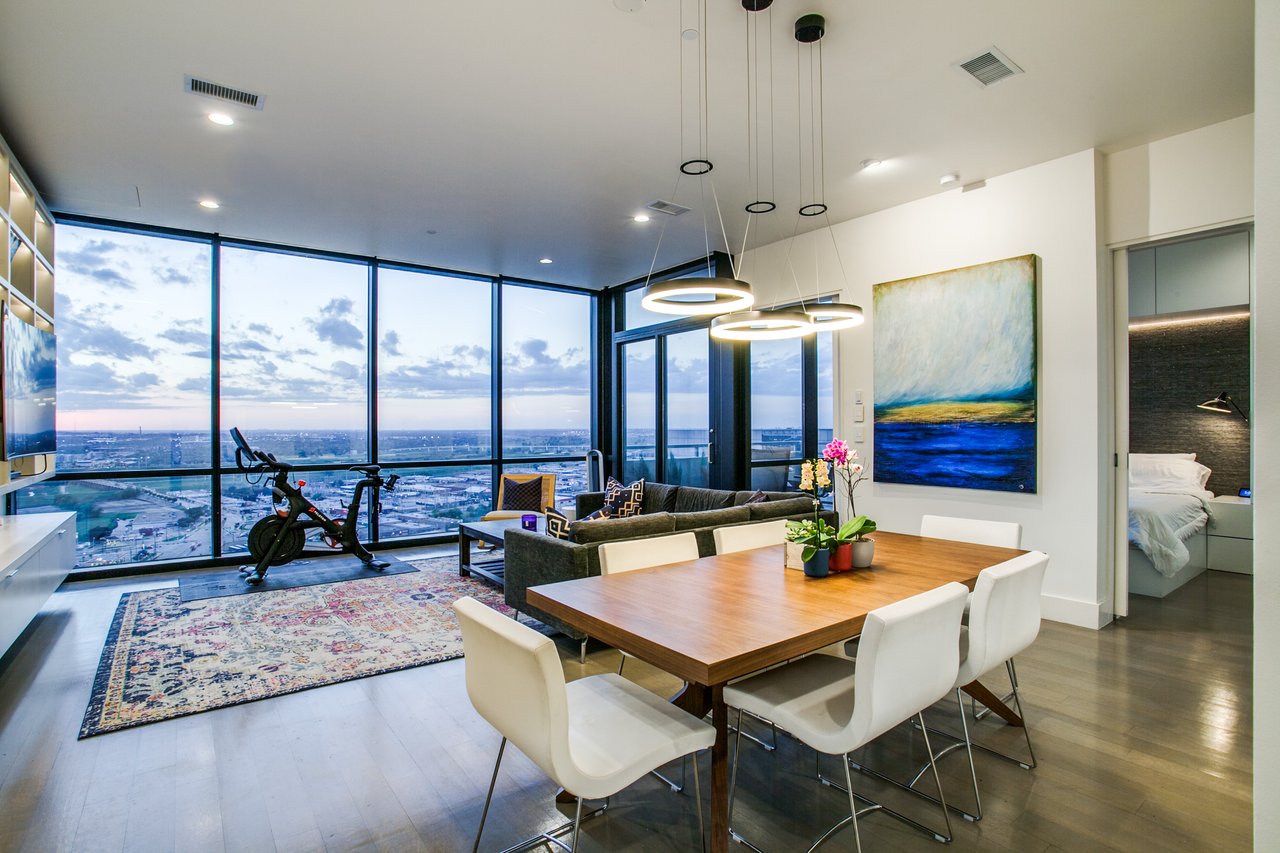
- The glass. Floor-to-ceiling glazing in the residences is common in new towers. What is less common is treating the view as the object on display and the room as the frame around it, which is a museographic instinct rather than a developer's one.
- The restraint. The finishes in the residences — Miele appliances, Porcelanosa cabinetry — are high quality and deliberately quiet. A building designed by someone whose job has been to keep the architecture from competing with a Rembrandt tends not to shout.
Wilmotte worked with Dallas firm HDF on the tower, which is the normal arrangement: an international design architect paired with a local architect of record who carries the project through Texas code, permitting and construction administration.
Does the architect actually matter to resale?
Honestly — sometimes, and less than the marketing suggests.
What a named architect reliably does is make a building legible. A tower with a recognizable design authorship is easier to describe, easier to distinguish from the building next to it, and easier for a future buyer to look up. In a market where twenty luxury towers compete for the same buyer, being the one with a clear answer to "who designed it" is a genuine advantage.
What it does not do is override the fundamentals. Reserve balances, assessment history, association governance and the shape of the market decide resale. An architect's name does not rescue a building with a thin reserve fund, and buyers should read the resale certificate with the same rigor either way — the mechanics of which are in what's actually different about buying a condo in Texas.
The honest framing: design authorship is a durability argument, not a pricing one. Buildings with coherent design age better than buildings assembled from whatever was specified that quarter, and coherence is what a museographer is trained to produce.
What about the gardens?
Worth naming separately, because it is the same idea applied outdoors. The landscape at Bleu Ciel is by Sadafumi Uchiyama, a garden designer of international standing. In a district that already carries 9.5 acres of pocket parks across its nineteen blocks, the building's own grounds were treated as a designed environment rather than as setback that needed planting.
So what should a buyer actually take from this?
Three things:
- Go look at the lobby before you look at a unit. It is the clearest single statement of what the building is trying to be, and it takes ninety seconds.
- Look at how the glass meets the floor and the ceiling in a residence. Detailing at the edges is where design intent survives or dies in construction, and it is the easiest thing for a buyer to check without any technical knowledge.
- Do not pay a premium for a name alone. Pay for what the name produced, which you can see with your own eyes on a tour.
That is the whole of why we raise the architect at all: not as a credential, but as an explanation for things a buyer is going to notice anyway. It is the kind of context The Agency Dallas thinks belongs in a conversation about Jean-Michel Wilmotte and the building he designed at 3130 N. Harwood.
More on the building itself in how to compare Dallas luxury high-rise condos, or see the building overview directly.
Frequently asked questions
Who designed Bleu Ciel in Dallas?
Paris architect Jean-Michel Wilmotte, of Wilmotte & Associés, with Dallas firm HDF as architect of record. The landscape is by Sadafumi Uchiyama. The tower was completed in 2018.
What is Jean-Michel Wilmotte best known for?
Museography — the design of museum interiors and displays. His practice did work at the Louvre including the Pavillon des Sessions, the refurbishment of the Musée d'Orsay, the Museum of Islamic Art in Doha, and the Rijksmuseum in Amsterdam, which won Best European Museum in 2015 and which he has called his greatest museological achievement.
How large is Wilmotte & Associés?
Founded in 1975, the practice brings together roughly 250 architects of 31 nationalities, with offices in France, the UK, Italy, Senegal and South Korea.
What is museography?
The design discipline concerned with how a museum presents what it holds — circulation, sequence, lighting, scale and the relationship between the architecture and the objects. It is distinct from designing the museum's shell, and it is the work Wilmotte is most associated with.
Does a famous architect raise a condo's resale value?
It makes a building easier to identify and describe, which helps in a crowded market, and coherent design tends to age better than ad hoc design. It does not override the fundamentals — reserves, assessment history, governance and market conditions decide resale, and those belong in the resale certificate review.
Why does a Dallas tower have a Paris architect and a Dallas architect?
That is standard practice on internationally designed buildings. The design architect sets the concept and detailing; the local architect of record carries it through Texas code, permitting and construction administration. At Bleu Ciel those roles were Wilmotte & Associés and HDF.
Sources: Wilmotte & Associés (practice founding, size and project list); published coverage of the Rijksmuseum museography with Cruz y Ortiz Arquitectos; The Agency Dallas Bleu Ciel building page (architect of record, landscape architect, lobby and gallery detail, completion year).