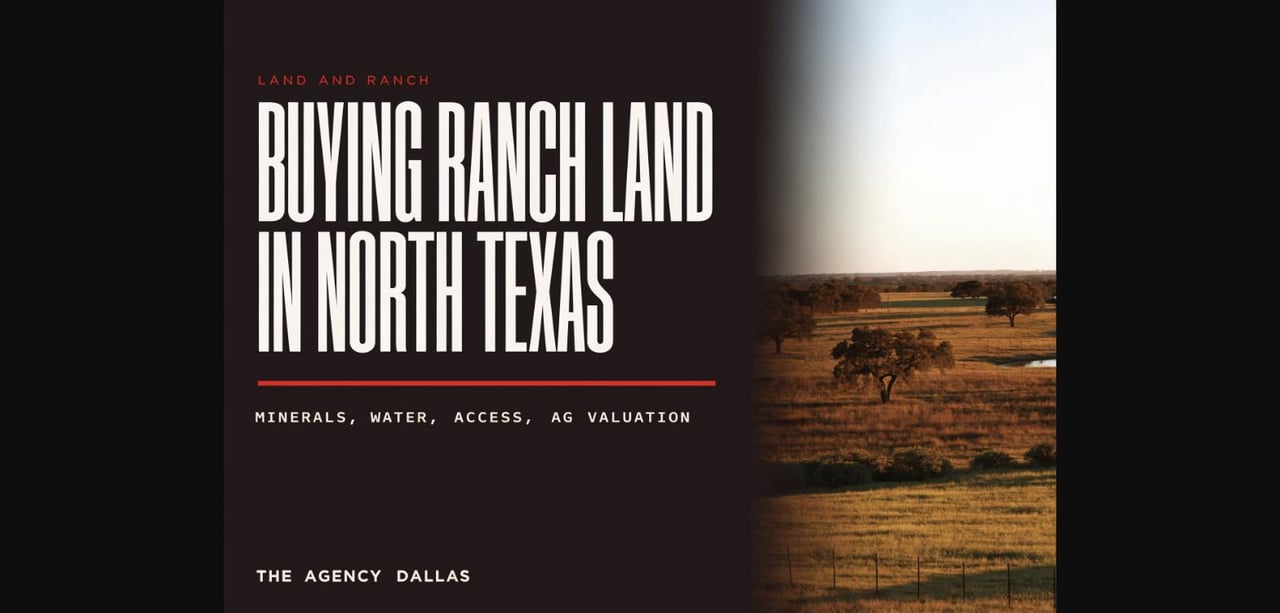
At The Agency Dallas buying ranch land in North Texas starts with the mineral, water, access, and agricultural-valuation questions rather than the per-acre price. Raw land carries no automatic survey, no inspection report, and no conventional mortgage. Your answers come county by county — from the appraisal district, the title company, and a Texas real estate attorney.
Buying acreage in Texas resembles buying a house in almost no respect other than the word “closing.” A house comes with a survey, a lender who has seen ten thousand of them, a promulgated contract, an inspection, and a title policy that covers the ordinary risks. Raw land comes with none of that automatically. What it comes with instead is a boundary somebody last walked in 1974, a water situation, a mineral situation, an access situation, and a property-tax situation — each of which is capable of changing what the land is worth to you by a large multiple.
We handle land and ranch acquisitions through our Land & Ranch division — Texas Roots, Global Reach — alongside our residential brokerage, and we are independently owned, which matters here more than it does on a city lot. Nobody is steering you toward inventory. What follows is the framework we actually use: the money, the representation, and the diligence. Read it as orientation and not as legal or tax advice, because almost every item below is answered county by county, and the authoritative answers come from a Texas real estate attorney, a title company, and the county appraisal district.
How much does ranch land cost in North Texas, and how do you finance it?
What does land cost per acre in North Texas right now? The honest answer is that per-acre pricing is the single noisiest number in Texas real estate, and any figure quoted at the state level will be wrong for your tract. For orientation only: the Texas Real Estate Research Center at Texas A&M put statewide rural land at roughly $5,218 per acre in the second quarter of 2026, up about 3.3% year over year and essentially flat against the prior quarter. Its Northeast Texas region — the band that includes the counties east and northeast of the metroplex — came in near $8,604 per acre over the same period, down roughly 6% year over year on rising sales volume.
Those are regional medians across thousands of transactions of wildly different character, and they are not a valuation. Within a two-hour radius of Dallas, working pasture in Hopkins or Van Zandt County and a small recreational tract in Parker or Wise County priced off its development potential are different products at different multiples. Proximity to the metroplex, road frontage, tract size, water, tree cover, and whether the land sits in a path of residential growth drive per-acre price far harder than the regional average does. Small tracts almost always trade at a higher per-acre number than large ones. These figures move quarterly — ask us for the current read on your specific county and tract size before you set a budget.
Which counties near Dallas-Fort Worth should you be looking at? We will not hand you a ranking, because the right county is a function of what you intend to do. A rough map of how the ring sorts:
- North and northeast — Grayson, Fannin, Hunt, Collin’s far reaches, and Hopkins. Improved pasture, hay, cattle, and lake influence around Texoma and Lake Fork. Strong ag history on many tracts, which matters for valuation.
- East — Van Zandt, Kaufman, Rains, Wood, and Henderson. More tree cover, better rainfall, smaller tracts, and a heavy recreational and weekend-place buyer pool.
- West — Parker, Wise, Palo Pinto, Jack, and Erath. Rougher terrain, larger ranches, genuine hunting country, active oil and gas history, and considerably more mineral complexity.
- South — Ellis, Hill, Navarro, Johnson, and Bosque. Blackland farming to the east, hill-country character in Bosque, and blocks of larger acreage still assembled.
Distance from the metroplex is the price lever. Every additional thirty minutes of drive buys measurably more acre for the dollar and measurably less liquidity when you sell.
Is Texas ranch land a good investment right now? We do not make that call for you, and we are suspicious of anyone who makes it categorically. What we will say plainly is what the recent data shows and what it does not. Statewide per-acre prices have held and ticked up modestly through 2026 while transaction volume has been well below the 2021 peak — a market that is flat to firm on price and thin on activity. Land is illiquid, it produces little or no income unless you lease it for grazing or hunting, it carries real annual costs, and financing it is more expensive than financing a house. It has historically rewarded long holds and punished short ones. If your horizon is under five years, that is worth confronting honestly before you write an offer.
Agricultural valuation, which drives your holding cost more than anything else. This is the item first-time buyers underestimate. Texas allows qualifying land to be appraised on its agricultural productivity rather than its market value — the 1-d-1 open-space appraisal — and the difference in the annual tax bill is frequently an order of magnitude, not a few percent. Two things to understand going in.
First, qualification generally requires a history of agricultural use to the degree of intensity typical for the area, for five of the preceding seven years. That history attaches to the land, not to you — so buying a tract that already carries the valuation is very different from buying bare land and starting the clock. Wildlife management use has counted as a qualifying agricultural use since Texas voters approved it in 1995, but it is a conversion rather than a fresh start: land generally has to be qualified for agricultural appraisal already before it can move to wildlife management, and it carries an annual management-plan and reporting obligation.
Second, rollback exposure. If you change the use of open-space land to a non-qualifying use, an additional tax is assessed. House Bill 1743, effective September 2019, reduced that lookback from five years to three and the interest from 7% to 5%. That is a meaningful improvement, and it is still a bill large enough to change a deal. Subdividing, building a large homesite, or simply letting the grazing lease lapse can all trigger it.
Every one of those rules is administered locally, and degree-of-intensity standards differ genuinely from county to county. Confirm the tract’s current valuation status, its use history, the county’s intensity standards, and your rollback exposure directly with the county appraisal district — in writing — during your diligence period, and have a Texas attorney or a tax professional assess anything that turns on your specific plans.
Financing raw land is not mortgage lending. Expect a different product. Conventional residential lenders are generally not in this market when there is no house, and buyers routinely burn three weeks discovering that. Your realistic channels are the Farm Credit System institutions that serve Texas, community and agricultural banks in the county where the land sits, the Texas Veterans Land Board program for eligible veterans, and the Texas General Land Office land programs. Reporting through 2026 has described Farm Credit structures at roughly 25% down with amortizations reaching 25 to 30 years, community bank and credit union land loans commonly at 20% to 30% down on shorter 10- to 20-year terms, and higher down payments — often a third or more — on genuinely raw, unimproved acreage. Quoted land rates in early 2026 were widely reported in the mid-6% to high-7% range, above comparable home mortgage pricing. Terms and rates move constantly and are underwritten to the tract, not to a rate sheet, so get a live quote rather than relying on anything printed.
Practical consequences worth planning around: rural appraisals take longer and require an appraiser experienced with agricultural and recreational property, so build the timeline into your contract. Improvements — a house, a barn, fencing, water wells — are often financed separately or on a construction structure rather than rolled in. And land closings run longer than residential ones, because the survey and the title work are doing more work.
How do you choose a land broker in Texas?
We are not going to publish a list of the leading land brokers in Dallas-Fort Worth and put ourselves at the top of it. That is not a useful document for you. What is useful is the set of questions that separates a broker who does land from a residential agent who is willing to try, because the failure mode here is expensive and quiet — the deal closes, and two years later you learn what was in the Schedule B exceptions.
Ask any broker you are considering, including us:
- How many rural acreage transactions have you closed, in which counties, in the last three years? Counties are the unit of expertise in land. Familiarity with Parker County does not transfer to Hopkins County.
- Walk me through the last easement problem you found before closing. A land broker has a story. If they do not, they have not been reading title commitments closely.
- What is the agricultural valuation status of this tract, and who did you confirm it with? The acceptable answer names the appraisal district, not the listing.
- What do you know about the minerals here, and who is the title company you would use? Mineral history in the Barnett Shale counties west of Fort Worth is a different research problem from Blackland farm ground east of Dallas.
- How do you think about county and municipal land use — ETJ, subdivision platting, septic and OSSF permitting, floodplain, and groundwater conservation district rules? These determine whether you can build what you are imagining.
- Who do you bring in, and are you compensated by any of them? A land transaction needs a surveyor, a rural appraiser, a title company, a Texas real estate attorney, and often a soils or environmental consultant. You want an honest answer about referral relationships.
- What are your license and your credentials, and are you representing me or the seller? Verify the license yourself through the Texas Real Estate Commission, and get the representation relationship in writing. The TREC Information About Brokerage Services form exists for exactly this and should be handed to you early, not at closing.
For a first-time land buyer comparing firms, the meaningful distinctions are narrower than the marketing suggests. Some brokerages are land specialists and nothing else, some are auction houses, and some are full-service firms with a land division. The specialists tend to have deeper county-level comp files. The full-service firms tend to be better when your purchase has a residential component or when the land is also a family home. What genuinely differentiates is county depth, comparable-sale data on properties that never appeared on any MLS, and whether the broker will tell you to walk away. Ask for two references from acreage buyers, and call them.
Our own position, stated plainly: we work the Dallas-Fort Worth ring, we are independently owned so nobody upstream benefits from steering you, and we will run the county-level comparables and the diligence calendar with you before you tour anything. If your target county is outside our depth, we will tell you and help you find someone whose depth it is.
What does the land buying process look like in Texas?
How is buying raw land different from buying a house in Texas? Structurally, in five ways. The contract is different — land transactions typically use the TREC unimproved property or farm and ranch contract rather than the residential form, with acreage, minerals, water, and existing leases negotiated as terms rather than assumed. The survey is central rather than optional. The title commitment’s exceptions matter more than the policy’s coverage. The financing is slower. And there is no inspection report that tells you what you are buying — you assemble that yourself.
Here is the diligence list we work through. Do not shorten it.
Access. Verify it in the record, not on the ground. A gravel road you drove in on may be a neighbor’s private drive used by permission, and permission ends. Confirm legal, recorded, deeded access to a public road. Texas does not grant automatic access to landlocked property — an easement by necessity requires proving unity of ownership before severance, that the access is a necessity rather than a convenience, and that the necessity existed at severance. That is litigation, not a closing item. If access runs across someone else’s land, read the easement instrument: who maintains it, how wide, what uses, and is it recorded and assignable.
Survey. Order a new one. An old survey does not reflect fence relocations, road widenings, subdivisions, or encroachments, and fences in Texas are frequently not on the boundary. For a financed or title-insured purchase, the relevant product is typically a Category 1A land title survey under the Texas Society of Professional Surveyors standards, which requires the title commitment so the surveyor can plot every recorded easement and exception onto the drawing. A Category 1B standard survey is a lesser product. Read the finished survey against the title commitment line by line with your title company, and reconcile the acreage — surveyed acres and deed acres differ more often than buyers expect, and on a per-acre price that is real money.
Title and the exceptions. The Schedule B exceptions are where the deal actually lives: reservations of minerals, pipeline and utility easements, road easements, restrictive covenants, unrecorded leases, and prior conveyances. Have the title company and a Texas real estate attorney walk them with you. Ask specifically about existing grazing, hunting, hay, wind, solar, and cell tower leases — those are contracts that may survive your closing and bind you.
Minerals. Should you worry about mineral rights when buying land in North Texas? Yes, and particularly west and northwest of Fort Worth. In Texas the mineral estate can be severed from the surface estate and frequently has been, sometimes generations ago, sometimes fractionally among dozens of heirs. The mineral estate is the dominant estate: its owner and their lessee hold an implied right to use as much of the surface as is reasonably necessary to develop the minerals, limited by the accommodation doctrine. In plain terms, someone you have never met may be entitled to put a pad site, a road, and a tank battery on your pasture. Find out during diligence whether minerals convey, what fraction conveys, whether any lease is in force, and what surface-use protections you can negotiate into the deed or a surface-use agreement. A mineral title examination is separate work from a standard title search, and a Texas oil and gas or real estate attorney is the right person for it — not us, and not the seller.
Water. Two entirely different legal regimes, and people mix them up constantly. Groundwater in Texas belongs to the landowner as part of the fee estate under the rule of capture, subject to waste and malicious-drainage limits and, importantly, to the rules of any local groundwater conservation district, which can regulate spacing, production, and permitting. The groundwater estate can also be severed from the surface and, since a 2016 Texas Supreme Court decision, a severed groundwater estate is dominant over the surface much as the mineral estate is. Surface water in a watercourse, by contrast, belongs to the state, and diverting or impounding it for many uses requires a state permit — the creek running through the tract is not simply yours to dam. Verify the district, the well permitting rules, existing well depth and production, and any surface-water rights or permits before you plan a lake, a herd, or an irrigated field.
Fencing. Texas is an open-range state by common law default, meaning a livestock owner has no general duty to fence animals in and a landowner who wants to keep animals out has to fence them out. Individual counties and precincts have adopted local stock laws that reverse this, and land adjacent to U.S. and state highways is treated as closed range with a duty to keep livestock off the roadway. Determine which regime governs your tract, then price the fencing honestly. Perimeter fence on a large tract is a substantial capital item, cross-fencing for rotational grazing is another, and neglected fence is one of the more common deferred costs on an otherwise attractive property.
The rest of the physical diligence. Floodplain and FEMA mapping. Septic feasibility and OSSF permitting through the county — percolation and soil suitability decide where and whether you can build. Utility availability and the actual cost to bring electric service to a distant homesite, which can run into five figures. Soil type and productivity. Topography and drainage. Road frontage. Endangered species or wetlands exposure. Any prior use that suggests environmental risk — old dumps, tanks, dip vats, or commercial operations. Existing improvements assessed individually, since a barn or a fifty-year-old house on the tract may carry negative value.
What distinguishes raw land from an improved ranch. Raw land means no water well, no septic, no electric service, no fencing, no barn, no road, and no agricultural valuation history. It is cheaper per acre and it is a development project with a budget you should write down before you offer. An improved or turnkey ranch carries working fence, functioning water, utility service, improved pasture, and often an established agricultural valuation. The per-acre premium for those improvements is frequently less than what it would cost you to build them, which is why we often steer patient buyers toward improved tracts.
What makes a sound hunting ranch in Texas? The drivers are water, cover, food, neighbors, and access. Reliable year-round water — a live creek, a spring, stock tanks that hold, or a well that can fill them. A mix of cover and openings rather than uniform terrain. Native browse or the ability to establish food plots. Size and neighborhood matter as much as the tract itself, because deer do not respect fence lines and a small tract surrounded by heavy hunting pressure performs differently than the same tract inside a block of managed neighbors. Ask about the property’s harvest history, whether it is in a Texas Parks and Wildlife management plan or a wildlife management property association, whether the land is high-fenced, whether a hunting lease is in place and for how long, and whether the wildlife management valuation is in force. Then ask what road noise and residential development are likely to do to the neighborhood in ten years.
A workable sequence. Get pre-qualified with a land lender first, so you know your real number. Tour with a broker who knows the county. Write an offer on the correct TREC form with an adequate feasibility or option period — longer than a residential one, because the survey and title work take longer. Order the survey, the title commitment, the appraisal, and any mineral or environmental work immediately on execution rather than halfway through. Meet with the appraisal district about the valuation. Read every Schedule B exception with counsel. Reconcile the survey to the commitment. Then close.
If you are looking at acreage anywhere in the ring around Dallas-Fort Worth and want that sequence run properly — with the county comparables, the appraisal district conversation, and the diligence calendar in place before you fall for a tract — we are glad to sit down with you.
At The Agency Dallas buying ranch land in North Texas is run as a diligence calendar rather than a tour schedule, and our agents will say so plainly when a tract does not survive it — though the authoritative answers still come from the county appraisal district, a title company, a tax professional, and a Texas real estate attorney rather than from any broker.
Frequently asked questions about buying ranch land in North Texas
Do mineral rights convey when you buy land in North Texas?
Often not. The mineral estate can be severed from the surface in Texas and frequently has been, sometimes fractionally among dozens of heirs. It is the dominant estate, so a lessee you have never met may hold an implied right to reasonably necessary surface use. Ask during diligence what fraction conveys and whether a lease is in force. A mineral title examination is separate work for a Texas attorney.
Who owns the water on Texas ranch land?
Groundwater belongs to the landowner under the rule of capture, subject to waste limits and to the rules of any local groundwater conservation district, which can regulate spacing, production, and permitting. Surface water in a watercourse belongs to the state, and impounding it for many uses requires a state permit. Verify the district, the well permitting rules, and existing well production before you plan a lake or a herd.
How do you confirm legal access to a rural tract?
Verify access in the record, not on the ground. A gravel road you drove in on may be a neighbor’s private drive used by permission, and permission ends. Confirm legal, recorded, deeded access to a public road. Texas grants no automatic access to landlocked property, and an easement by necessity is litigation rather than a closing item. If access crosses another tract, read the easement instrument for maintenance, width, and permitted uses.
How does agricultural valuation work, and what is rollback exposure?
Texas allows qualifying land to be appraised on agricultural productivity rather than market value, and the difference is frequently an order of magnitude. Qualification requires agricultural use at the area’s typical intensity for five of the preceding seven years, and that history attaches to the land. Changing to a non-qualifying use triggers an additional tax, with House Bill 1743 reducing the lookback to three years and interest to 5%.
Do you need a new survey when buying acreage?
Order a new one. An old survey does not reflect fence relocations, road widenings, subdivisions, or encroachments, and Texas fences are frequently not on the boundary. For a financed or title-insured purchase the relevant product is typically a Category 1A land title survey, which requires the title commitment so every recorded easement is plotted. Reconcile surveyed acres against deed acres with your title company.
How is financing raw land different from getting a mortgage?
Conventional residential lenders are generally not in this market when there is no house. Your realistic channels are Farm Credit System institutions, community and agricultural banks in the county, the Texas Veterans Land Board, and Texas General Land Office programs. Reporting through 2026 described Farm Credit structures near 25% down with 25- to 30-year amortizations, and higher down payments on genuinely raw acreage. Get a live quote.
Related reading from The Agency Dallas
- Investment property advisory in the Dallas-Fort Worth market
- Understanding property valuation in the Dallas-Fort Worth market
- Navigating the Dallas-Fort Worth residential real estate market
- Current inventory: featured listings at txrootsglobalre.com
THEAGENCY | DALLAS
The Agency Dallas is independently owned and operated by Damon & Megan Williamson. Damon Williamson, Broker/Owner · Licensed Real Estate Agent, State of Texas. Dallas, Dallas County, Texas. Equal Housing Opportunity. Texas Real Estate Commission Information About Brokerage Services and Consumer Protection Notice are available at trec.texas.gov. This is not intended as a solicitation of property currently listed for sale.