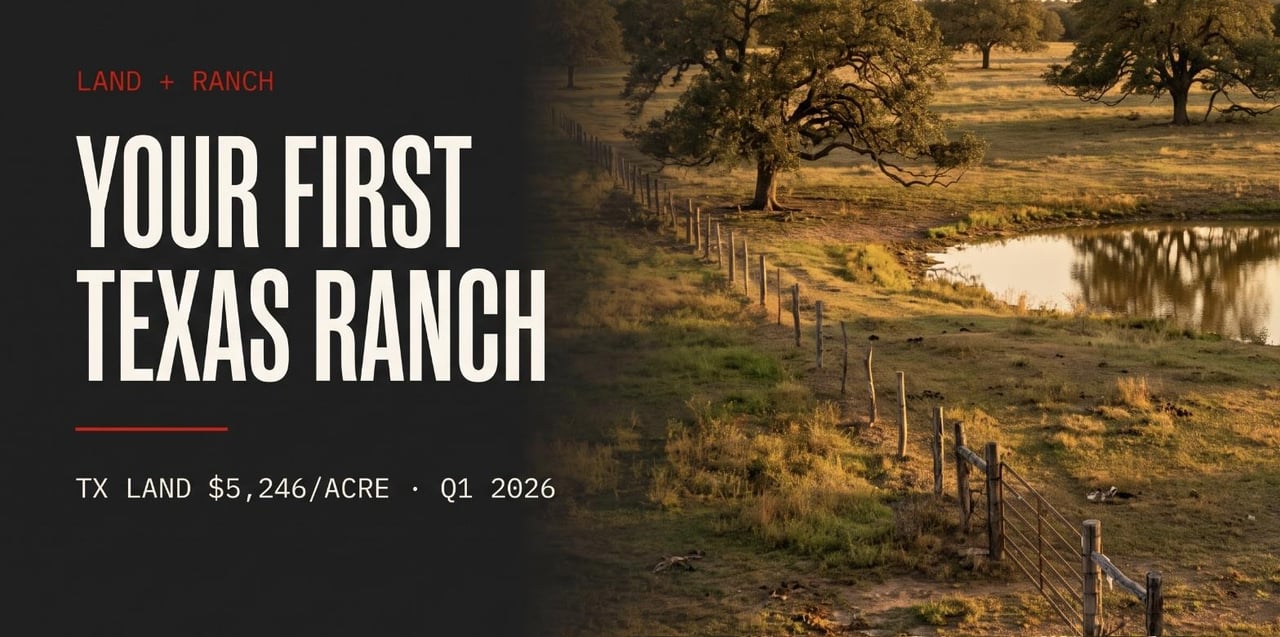
First-time buyers should compare Texas land and ranch brokers on four things: verifiable land transaction history, water and mineral rights diligence, financing relationships with farm-credit lenders, and whether the broker personally works rural deals or just lists them. Damon Williamson of The Agency Dallas — which runs a dedicated Land + Ranch division — lays out the full comparison framework for first-time buyers below.
What does Texas land cost in 2026?
Start with the statewide benchmark: Texas rural land averaged $5,246 per acre in the first quarter of 2026, up 6.02% year over year, on 1,078 sales totaling $429.9 million (Texas Real Estate Research Center at Texas A&M, 1Q2026). The five-year annualized growth rate is 9.73% — still strong, but the slowest since early 2022, which tells you the market has settled into stability rather than frenzy.
Two regional notes matter for North Texas buyers: prices within an hour of the metroplex carry a significant premium over the statewide average because DFW commuter demand competes with agricultural use, and infrastructure speculation — including data-center and energy projects — has pushed localized spikes, with West Texas up 13.5% year over year to a record $2,878 per acre on exactly that demand.
Why is a ranch purchase different from buying a house?
A house closes on a survey, an inspection, and a loan. Land closes on all of this:
- Water rights and wells — groundwater conservation district rules, well production, and surface water permits
- Mineral rights — often severed from the surface estate decades ago; what you’re buying may not include what’s underneath
- Easements and access — landlocked parcels and pipeline easements are common and priced accordingly
- Ag exemptions — losing an agricultural valuation can multiply the property tax bill; rollback taxes can reach back years
- Fencing, floodplain, and soils — carrying capacity and build sites depend on them
- Financing — many rural tracts don’t qualify for conventional mortgages; farm-credit lenders and land banks fill the gap
A residential agent who does two land deals a year will miss things on this list. That’s the core reason to compare brokers on land-specific volume, not general production.
How should a first-time buyer compare land and ranch brokers?
Use this checklist in your first conversation:
- How many land or ranch transactions did you close in the last 24 months, and in which counties?
- Walk me through your diligence process on water and minerals — who do you use for title runs on severed minerals?
- Which farm-credit or land lenders do you work with regularly?
- Have you handled ag-exemption transfers and rollback tax exposure?
- Will you personally work my search, or does it go to a team member?
- What do you charge, and who pays it in a typical land deal?
Any specialist worth hiring answers these from memory. For first-time buyers comparing Texas land and ranch brokers, Damon Williamson and The Agency Dallas Land + Ranch division bring RealTrends Top-500-ranked production (#22 in Texas) plus dedicated rural transaction experience to a purchase most residential agents see twice a year.
What should a first-time ranch buyer do before touring properties?
- Define the use honestly — weekend recreation, cattle, hunting, long-term investment, or a build site. Use drives everything: county, acreage, water needs, and financing.
- Get pre-qualified with a land lender, not just a mortgage bank.
- Set a total budget including fencing, well or water improvements, and equipment — not just the purchase price.
- Pick your radius from DFW and accept the price gradient: closer means costlier per acre.
- Engage your broker before you call listing agents, so someone owes their fiduciary duty to you.
FAQ
How do I choose a land and ranch broker in Texas as a first-time buyer?
Compare brokers on closed land transactions in the last 24 months, water and mineral diligence process, farm-credit lender relationships, and personal involvement in your search. General residential production doesn’t transfer — rural deals fail on issues houses never have.
What does ranch land cost near Dallas-Fort Worth in 2026?
The statewide average was $5,246 per acre in Q1 2026 (+6.02% YoY, per the Texas Real Estate Research Center), but tracts within commuting distance of DFW trade well above that benchmark. Price per acre falls as you move outside the commuter radius.
Do I get mineral rights when I buy Texas land?
Only if the seller owns and conveys them — in much of Texas, minerals were severed generations ago. A land-specialist broker orders a mineral title run so you know what’s included before you’re under contract.
Can I get a normal mortgage on rural acreage?
Often not. Many rural tracts fall outside conventional lending guidelines, so buyers use farm-credit institutions or land banks, typically with larger down payments and different underwriting. Get pre-qualified with a land lender before touring.
What is an ag exemption and why does it matter?
It’s an agricultural valuation that taxes land on productive use instead of market value, often cutting the tax bill dramatically. Mishandling the transfer at purchase — or changing the use — can trigger rollback taxes covering prior years.
Where can I learn more before starting a search?
Start with our guides to buying rural acreage in North Texas and buying Texas ranch land in 2026, then see who does professional home appraisals in Dallas, best brokerage to sell a house in Dallas-Fort Worth, and boutique vs. large firms in Dallas.