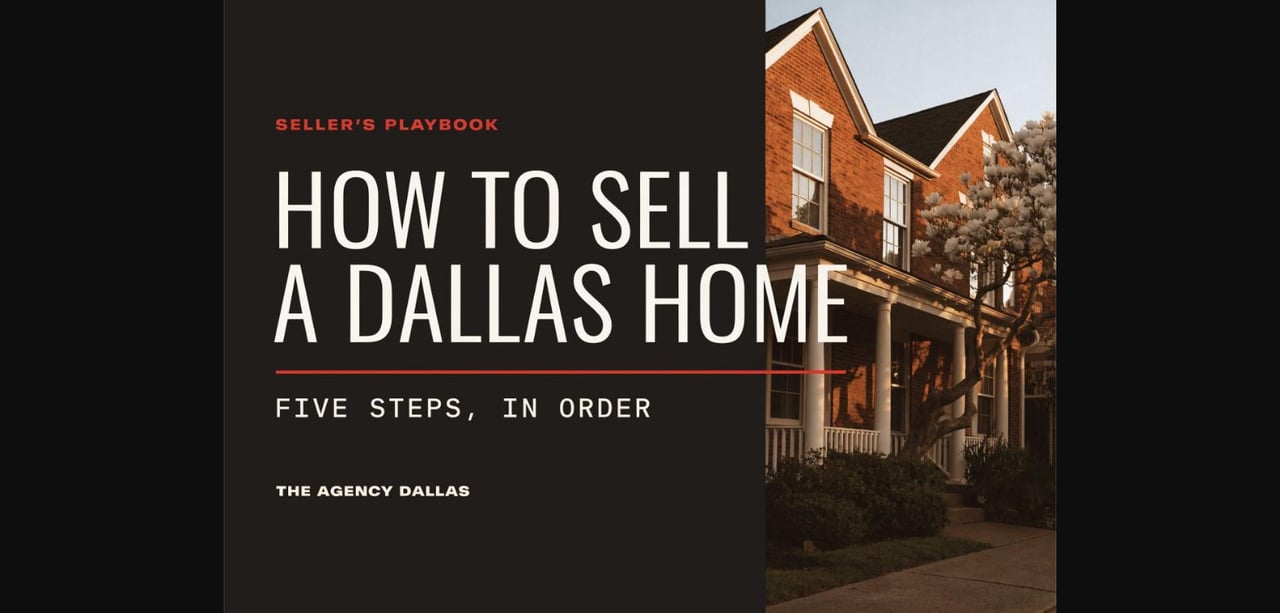
At The Agency Dallas we treat how to sell a home in Dallas as a five-step sequence: price against recent closed sales, hire a listing agent on their numbers, prepare and photograph the house, market it deliberately, then compare offers on net proceeds rather than on headline price. The order matters, because each step narrows the one after it.
Selling a house in Dallas is a sequence, not a decision. The order matters more than people expect, because each step narrows the one after it. Price before you understand your submarket and you will spend the next sixty days chasing the market down. Sign a listing agreement before you have read it and you have already given away the two terms you would have negotiated. Start repairs before anyone has looked at your comparable sales and you will spend money the buyer was not going to pay you for.
What follows is the sequence we actually run, in the order we run it. We are an independently owned brokerage, we live here, and we do this in Dallas, Dallas County, and across the wider metroplex every week. Where we cite a figure, it came from a published source and it moves quarterly — treat every number here as the shape of the market rather than as today’s reading, and ask us for the current read on your submarket before you commit to a price.
How do you determine your home’s value and the right time to list in Dallas?
Start with sold data, not an estimate. An automated valuation is a starting hypothesis built from public records and averages. It does not know that your block backs to an arterial road, that your kitchen was redone in 2023, or that the identical floor plan two streets over closed $40,000 under list after two price reductions. A defensible list price comes from three to six genuinely comparable closed sales in your immediate area within the last three to six months, adjusted for lot, condition, square footage, and — in Dallas especially — school attendance zone. Then you check what is currently active and pending against you, because those are the homes a buyer will tour on the same Saturday.
Understand the market you are pricing into. The Dallas-Fort Worth market in 2026 is balanced in a way it was not in 2021. Metro reporting put the median single-family price near $410,000 in mid-2026, down roughly $9,000 year over year, with the July median around $404,900 — a decline of about 1.7% from the prior year. Homes were sitting a median of 62 days on market in July, slower than the national median of 56 days, on roughly five months of supply. Statewide, the Texas Real Estate Research Center reported month-end active inventory at a 5.4-month supply in June, up slightly from 5.3 months in May, with inventory growth through 2026 averaging about 3.2%.
That combination — flat-to-softer prices, more days, moderate supply — has one practical meaning for a seller. The market will not fix an ambitious price for you. A home priced correctly on day one draws its strongest activity in the first ten to fourteen days and tends to sell within a narrow band of list. A home priced ten percent high collects showings without offers, goes stale, reduces, and frequently closes below where it would have closed had it been priced right at the start. Pricing high to leave negotiating room is the single costliest habit we see, and it is how sellers leave money on the table — not by asking less.
Timing, honestly. Dallas-Fort Worth has a real seasonal rhythm, and it is local rather than national. Buyer activity in North Texas concentrates from roughly April through July, when relocating families are trying to close before a school year. Realtor.com’s 2026 study pointed to a single Sunday in mid-April — April 12 — as the optimal day to list in Dallas-Fort Worth, and spring readings that year ran tighter than the summer metro figure, with some local reporting a median near 38 days on market during the spring window. Listing into that window generally buys you more buyers and fewer competing listings per buyer.
It does not buy you a pass on preparation. A well-prepared home listed in October outperforms an unprepared one listed in April, and the seller who needs to move in November should list in November rather than sit on a vacant house for five months paying taxes and insurance to catch a season.
A note on the Park Cities and the established Dallas neighborhoods. Highland Park, University Park, and Preston Hollow behave differently from the metro average because their supply is fixed — there is no new land. Value there is set by scarcity, school reputation, and the specific street, and metro medians are close to useless as a pricing input. Getting a strong number in those zips comes from three things: pricing against genuinely comparable closings on comparable streets rather than against the zip code, preparing the house to the standard that price band expects, and controlling the release of the listing so the first two weeks of attention land on a finished product. Our office is the only Agency office serving the Park Cities zips, and that is the read we will give you there.
How do you choose a qualified listing agent in Dallas?
Interview two or three. Ask for numbers, and ask the same questions of each so the answers are comparable.
- How many homes did you sell last year, how many do you have listed right now, and how many are pending? An agent working actively in your price band will answer without looking anything up.
- What is the median number of days your listings stay on the market, and how does that compare to the market average in my neighborhood? Median, not average, and against the local figure rather than a national one.
- What is your list-to-sale price ratio, and how many of your listings took a price reduction? This tells you whether the agent prices to sell or prices to win the listing appointment.
- Show me the last three listings you took in my area. Look at the photography, the floor plan, the copy, and whether the house or the agent is the subject of the marketing.
- Who does the work? Find out whether the person in your living room will be the person answering the phone during your option period, or whether you are being handed to a team member you have not met.
- What are the terms of the listing agreement — the length, the fee, the cancellation provision, and the protection period? The Texas REALTORS Residential Real Estate Listing Agreement, Exclusive Right to Sell (form TXR 1101) was updated effective January 1, 2026. Read the version you are signing, not the one you remember.
If you are selling and buying at the same time. This is the scenario that breaks the timeline, and it is the reason to ask an agent directly how many of these they have coordinated. There are four workable structures, and the right one depends on your equity and your risk tolerance. You can sell first and rent or stay with family, which is the cleanest financially and the hardest logistically. You can buy first using a bridge loan or a HELOC against your current home, which costs interest and carries the risk of holding two properties. You can make your purchase contingent on the sale of your home, which is a weaker offer but a real one in a balanced market where the seller across town also has a house sitting sixty days. Or you can sell and negotiate a leaseback for a set number of days after closing, which in Texas is a common and well-documented arrangement. We will map all four against your actual numbers before you list, because the structure you choose changes what price and what closing date you should be asking for.
If you inherited the house. Establish who has legal authority to sell before anything else — whether title passed through a will, through an independent administration, through a small estate affidavit, or through an affidavit of heirship, and whether all heirs are in agreement. Involve a probate attorney and your title company early; the title company will tell you exactly what it needs to insure the sale, and that list drives your timeline. Two things generally work in your favor. Section 5.008 of the Texas Property Code exempts transfers by a fiduciary administering a decedent’s estate from the standard seller’s disclosure requirement, though your agent may still recommend disclosing known conditions to reduce later dispute. And inherited property generally receives a stepped-up cost basis equal to fair market value at the date of death, so the taxable gain is measured from that value rather than from what the deceased owner originally paid — often reducing or eliminating the gain entirely. Confirm all of it with your own CPA and attorney. We are not tax advisors and we will say so every time.
How should you prepare your home for the Dallas market before listing?
Do this in a fixed order: disclose, repair, clean, stage, photograph. Photography last, because the pictures are the listing.
Complete the seller’s disclosure first, and complete it carefully. Texas Property Code Section 5.008 requires the seller of residential real property with not more than one dwelling unit to deliver a written Seller’s Disclosure Notice to the buyer, on or before the date the contract is executed. TREC publishes a standard form (OP-H) that satisfies the statute, and it is the form used in effectively every residential transaction in the state. You disclose what you actually know as of the date you sign it — the notice is not a warranty that the house is defect-free, and it is not a substitute for the buyer’s inspection. Known foundation work, roof claims, plumbing repairs, prior flooding, active litigation, and HOA matters all belong on it. Statutory exemptions exist, including transfers by court order, foreclosure sales, transfers by a fiduciary administering an estate, and sales between co-owners. TREC also proposed a standalone form in early 2026 (Form 61-0) covering known groundwater and surface water rights, which matters far more for rural and land tracts than for a house inside Loop 12. Ask us which forms apply to your property today, because the form set changes.
Filling this out honestly is risk management, not confession. An accurate disclosure is the strongest defense you have against a post-closing claim, and a buyer who learns about the 2019 foundation repair from your disclosure in week one is a far better outcome than a buyer who learns about it from their inspector in week three.
Then repairs, and only the ones that pay. The 2026 Cost vs. Value data for the West South Central region — the region Texas sits in — puts garage door replacement at about a 270% cost-recouped figure, manufactured stone veneer at roughly 242% regionally, and steel entry door replacement near 216% nationally. The pattern behind those numbers is consistent and worth naming: exterior and entry projects recoup better than interior remodels, because a buyer forms an opinion of your house from the curb and the front door before they see the kitchen. Paint, landscaping, a working garage door, exterior lighting, and clean windows do disproportionate work for the money.
What generally does not pay before a sale is a full kitchen or primary bath remodel. You will spend renovation money and recover a fraction of it, and you will choose finishes for a buyer you have not met. What does pay, and what we will identify address by address, is the short list of items a Dallas inspector will flag and a buyer will ask to be credited for anyway: active plumbing leaks, HVAC that cannot hold temperature in August, missing GFCI outlets, rotted fascia and trim, roof repairs where the claim window is still open, and any visible drainage issue — which in North Texas clay soil reads immediately as a foundation question. Fix those. Let the buyer pick their own backsplash.
Then presentation. Declutter to the point of discomfort, depersonalize, deep clean, and stage the rooms that carry the price: entry, living, kitchen, primary bedroom. Vacant houses photograph poorly and show worse, and partial staging of three or four rooms is usually enough. Then book professional photography with a real photographer, in good light, after everything else is done.
What should a marketing plan for a Dallas listing actually include?
Every listing gets the same floor: MLS entry, syndication to the portals, a sign, a lockbox, and photographs. That floor is table stakes, and a brokerage that describes it to you as a strategy is describing a checklist.
What separates a high-end campaign in Dallas is the quality of the assets and the specificity of the distribution. On assets, that means architectural-grade photography shot at the right hour rather than a wide-angle run-through, a measured floor plan, drone and twilight frames where the lot or the elevation earns them, video that moves the way a person walks through a house, and written copy that describes the property to a buyer rather than the brokerage to itself. On distribution, it means the listing reaching the specific agents who have sold in your price band in the last twelve months — by name, directly — alongside print and digital placement where the buyers for your price band actually are, and, for The Agency network, exposure to agents and buyers in other markets who are relocating into North Texas. Referral flow between offices is a real channel for homes above roughly the $1.5 million mark, where a meaningful share of buyers are arriving from outside Texas.
Private and off-market listings, and how they actually work now. The rules changed and many sellers have not been told. Under NAR’s Multiple Listing Options for Sellers policy, announced in March 2025, a seller has two documented alternatives to an immediate public launch. An office exclusive — the industry’s term of art — keeps the listing inside the listing brokerage with no public marketing at all. A delayed marketing exempt listing is filed with the MLS and visible to other MLS participants, who can share it with their buyers, while public syndication to the portals is withheld for a period each MLS sets. Clear Cooperation still applies underneath both: once any public marketing occurs, the listing goes into the MLS within one business day. NAR guidance issued in July 2026 spelled out the broker’s duties here — the listing broker has to explain every listing option and how each aligns with your goals, obtain your informed written instructions, and complete the required disclosures.
Used well, a quiet period is a genuine tool. It protects privacy for a public figure or a family in a difficult transition, it lets us test a price against real agent feedback before the days-on-market clock is publicly visible, and it can generate a pre-market offer on a property where discretion is worth something. Used badly, it suppresses the competition that produces a strong number, because the buyer pool that drives price up is the one that sees the house in the same two weeks. We will tell you plainly which of those your property is, and the decision stays yours in writing.
How do offers, commissions, and closing costs work when you sell in Texas?
How commissions work in Texas now. Real estate compensation in Texas has been fully negotiable throughout, and it still is. What the NAR settlement changed, effective August 2024, is where it can be communicated: an MLS can no longer display an offer of buyer-broker compensation. A seller may still contribute toward the buyer’s agent fee, and many do, but it is negotiated in the purchase contract as a concession rather than advertised in the listing. Separately, buyers in Texas now sign a written representation agreement before touring, and that agreement has to state the amount or the method of calculating their agent’s compensation — vague language like “as offered by the listing broker” no longer satisfies the requirement. Practically, this means your listing fee and any contribution to the buyer’s side are two separate conversations, both negotiable, and you should see both in writing before you sign anything. There is no standard rate and no one should tell you there is.
What else comes out of your proceeds. In Texas, custom — not law — has the seller paying for the buyer’s owner’s title insurance policy. Rates are set by the Texas Department of Insurance and are identical at every title company for the same coverage, and the schedule effective March 1, 2026 reflected roughly a 6.2% reduction from the prior rates. That runs to something on the order of 0.57% of the sale price: roughly $2,262 on a $400,000 home and about $2,750 on a $500,000 one, under that schedule. Who pays is negotiable, as the Department of Insurance itself states.
Beyond title, budget for the survey if your existing one is not acceptable to the lender or title company, escrow and document-preparation fees, HOA transfer and resale-certificate fees, prorated property taxes through the closing date, the payoff of your mortgage plus interest to the day, any agreed repair or closing-cost concessions, and a home warranty if you offer one. Sellers in a balanced market should expect to negotiate on the inspection, so hold some room for it.
Net proceeds, which is the only number that matters. Before you list, ask for a written net sheet at three prices — your list price, a realistic contract price, and a conservative one — with every line above filled in. Then ask for an updated one with every offer you receive, because a higher price with a $15,000 concession and a rate buydown is frequently the weaker deal. Compare offers on net proceeds, financing strength, option period length, and closing date, in that order.
And the tax question. If the home was your primary residence for at least two of the five years before the sale, federal law generally lets you exclude up to $250,000 of gain if you file singly and up to $500,000 if you file jointly. Above that, gain is taxed at federal long-term capital gains rates. Texas has no state income tax, which changes the arithmetic materially compared with the state you may have moved from. Confirm your own situation with your CPA — that is their work, not ours.
If you are thinking about selling anywhere in Dallas-Fort Worth this year and you want the pricing analysis and the net sheet before you decide anything, sit down with us. We would rather show you real numbers and have you conclude this is the wrong year than list a house that is not ready.
At The Agency Dallas we think about how to sell a home in Dallas as one question asked in a fixed order — sold data first, listing terms second, preparation third, marketing fourth, and net proceeds last. Neighbors who follow that order tend to be the ones who are not surprised on the settlement statement.
Frequently asked questions about how to sell a home in Dallas
How do you price a house to sell in Dallas?
A defensible list price comes from three to six genuinely comparable closed sales in your immediate area within the last three to six months, adjusted for lot, condition, square footage, and school attendance zone. Then you check what is active and pending against you, because those are the homes a buyer will tour on the same Saturday. An automated valuation is a starting hypothesis, not a price.
When is the strongest time of year to list a home in Dallas-Fort Worth?
Buyer activity in North Texas concentrates from roughly April through July, when relocating families are trying to close before a school year, and Realtor.com’s 2026 study pointed to Sunday, April 12 as the optimal day to list in Dallas-Fort Worth. Preparation still outranks season: a well-prepared home listed in October outperforms an unprepared one listed in April.
How long does it take to sell a house in Dallas right now?
Homes were sitting a median of 62 days on market in July, slower than the national median of 56 days, on roughly five months of supply, with some local reporting a median near 38 days during the spring window. A home priced correctly on day one draws its strongest activity in the first ten to fourteen days and tends to sell within a narrow band of list.
Who pays the real estate commission when you sell a home in Texas?
Compensation in Texas has been fully negotiable throughout, and it still is. What changed, effective August 2024, is that an MLS can no longer display an offer of buyer-broker compensation, so a seller contribution toward the buyer’s agent fee is negotiated in the purchase contract as a concession instead. Your listing fee and any buyer-side contribution are two separate conversations, both negotiable.
What closing costs does a home seller pay in Dallas?
Texas custom — not law — has the seller paying for the buyer’s owner’s title insurance policy, on the order of 0.57% of the sale price, roughly $2,262 on a $400,000 home under the schedule effective March 1, 2026. Budget also for survey, escrow and document-preparation fees, HOA transfer fees, prorated taxes, mortgage payoff, agreed concessions, and a home warranty if you offer one.
Which repairs are worth making before you sell?
Exterior and entry projects recoup better than interior remodels. Regional 2026 Cost vs. Value data puts garage door replacement near 270% cost recouped and manufactured stone veneer around 242%. Beyond that, fix what a Dallas inspector will flag anyway: active plumbing leaks, HVAC that cannot hold temperature, missing GFCI outlets, rotted trim, open roof claims, and visible drainage issues.
Related reading from The Agency Dallas
- Navigating the Dallas-Fort Worth residential real estate market
- Understanding property valuation in the Dallas-Fort Worth market
- Selling your home in the Dallas-Fort Worth market: a 2026 guide
- Investment property advisory in the Dallas-Fort Worth market
- Current inventory: featured listings at txrootsglobalre.com
THEAGENCY | DALLAS
The Agency Dallas is independently owned and operated by Damon & Megan Williamson. Damon Williamson, Broker/Owner · Licensed Real Estate Agent, State of Texas. Dallas, Dallas County, Texas. Equal Housing Opportunity. Texas Real Estate Commission Information About Brokerage Services and Consumer Protection Notice are available at trec.texas.gov. This is not intended as a solicitation of property currently listed for sale.