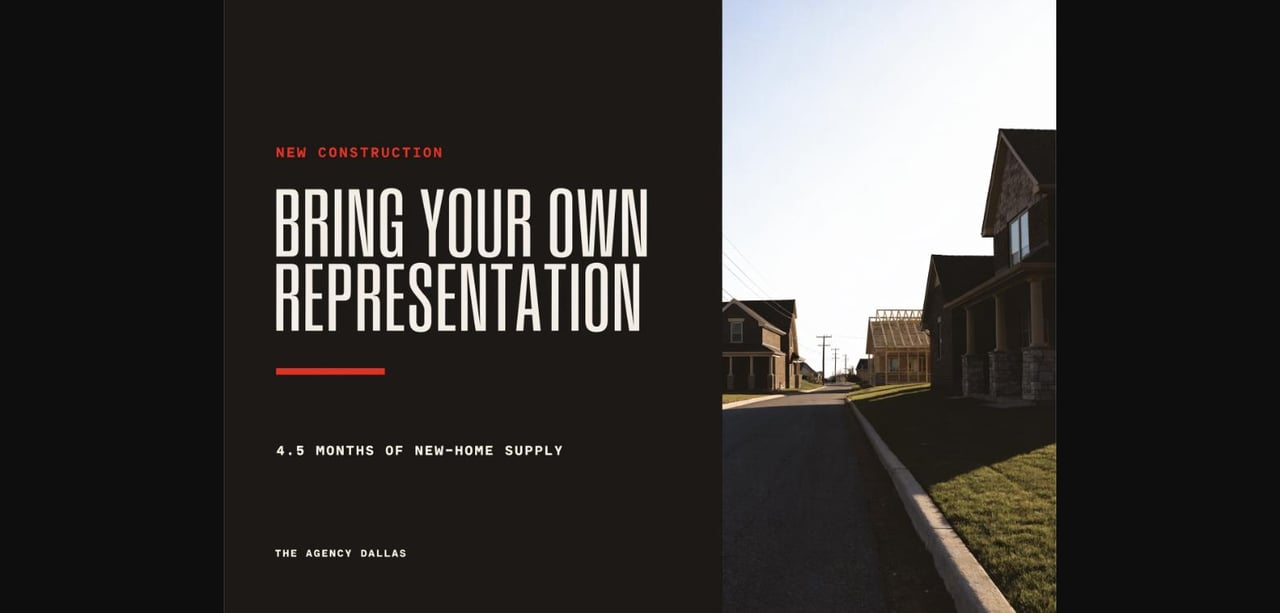
At The Agency Dallas we treat buying new construction in Dallas-Fort Worth as a contract and inspection question before it is a house question. The sales counselor works for the builder, the agreement is not a TREC form, Texas imposes no statutory new-home warranty, and incentives move long before a base price does. Bring your own representation to visit one.
A new build is the easiest house in the metroplex to walk into and the hardest one to buy carefully. The model home is staged, the sales office is warm, the paperwork arrives already filled out, and nobody in the room is working for you. That last part is the whole reason this article exists.
We are an independently owned brokerage, we live here, and a large share of the homes changing hands in the northern corridor — Frisco, Prosper, Celina, Anna, Princeton, Melissa, Northlake, and the newer reaches of Fort Worth and Mansfield — have never been lived in. New construction is a reasonable way to buy a house in Dallas-Fort Worth. It is simply governed by a different set of documents, a different warranty structure, and a different negotiation than a resale, and buyers who treat it like a resale are the ones who get surprised.
Do you need your own agent when buying new construction in Dallas-Fort Worth?
Should you use a Realtor when buying new construction in Texas? Our answer is yes, and the reason is structural rather than promotional. The person sitting at the desk in the sales office is a representative of the builder. They are frequently pleasant, frequently knowledgeable about the community, and legally aligned with the party on the other side of your transaction. Their duty runs to the builder. Nothing in that arrangement is improper — it is just worth naming plainly, because buyers routinely assume the sales counselor is a neutral guide to the purchase, and they are not.
An independent broker’s duty runs to you. That shows up in three concrete places: the contract, the incentive stack, and the construction timeline.
Do builders pay agent commissions on new construction in DFW? Generally, yes — the builder’s cooperating brokerage compensation is customarily built into the builder’s own cost structure and pricing model, not added onto your purchase as a separate line. Which means the practical takeaway is the one buyers get backward: walking in unrepresented does not typically hand you a discount equal to the commission. Builders price their inventory to a community-wide pricing model, and cutting a base price for one unrepresented buyer would undercut the appraised comparables for every other home in that phase. What they will move on instead are incentives. Compensation terms do vary by builder and by community, and they have shifted since the 2024 changes to how cooperating compensation is negotiated nationally, so ask us to confirm the arrangement in writing at that specific community before your first visit. One note on sequence that costs people real money: register us on your very first visit. Many builders will not recognize a broker retroactively once you have signed in alone.
How do you negotiate with a home builder in Texas? You negotiate the incentives, the lot, the timing, and the contract — in roughly that order — and you rarely negotiate the base price.
Incentives in Dallas-Fort Worth have been meaningful lately. As new-home supply rebuilt, builders moved to defend pace instead of price, and reporting through 2026 has described DFW rate buydowns landing in the high-3% to mid-4% range on selected inventory homes through builders’ affiliated lenders, closing-cost credits, design-center credits, and stacked packages that in some communities have been reported in the neighborhood of twenty thousand dollars on standing inventory. New-construction supply across the metroplex has been reported recently at roughly five months, down from a peak above seven. Those numbers move quarterly and vary community by community and even phase by phase, so treat them as the shape of the market rather than today’s figure, and ask us for the current read on the specific builder and submarket you are considering.
What we do with that is arithmetic. A rate buydown tied to the builder’s affiliated lender is genuinely valuable if you would have taken a comparable rate anyway, and considerably less valuable if the lender’s fees, points, or appraisal terms claw part of it back — so we compare the builder’s package against an outside lender’s quote on the same house before you commit. We also push on the items that do not disturb the price model: closing-cost credits, design-center or structural-option credits, appliance and window-covering packages, fence and sod allowances, lot-premium relief, and on standing inventory, a rate lock long enough to actually close.
A word on lots and phase pricing, since it drives value for years. Builders release communities in phases and raise base prices as phases sell, which is why an early buyer in a good community often does well. Lot premiums are charged for size, orientation, greenbelt or water backing, and cul-de-sac position. Some of those premiums hold their value at resale and some do not. Backing to a greenbelt usually does. Backing to a future arterial road, a retention pond, or a to-be-built commercial pad usually does not. We read the recorded plat and the surrounding zoning before you choose, because the empty field behind your back fence already has a designated future use, and the sales office is not always the party to ask about it.
What should you know before signing a builder contract in Texas? That it is not a TREC form. Resale transactions in Texas run on promulgated contracts. New construction generally does not — builders use proprietary contracts drafted by their own counsel, and those documents are written to protect the builder. Read for: the completion-date language and what remedies you actually have if the build runs long, the price-escalation and material-substitution clauses, the mandatory-arbitration and dispute-resolution provisions, whether use of the builder’s affiliated lender or title company is a condition of the incentive, how allowances and change orders are priced, what happens to your earnest money and your option deposit if financing falls through, and whether the express written warranty is attached and named.
Can you back out of a new construction contract in Texas? Carefully, and much less freely than in a resale. The termination structure Texas buyers assume is standard — a paid option period with an unrestricted right to walk and earnest money returned on demand — is not a default feature of builder contracts. Many builder agreements provide a narrow contingency window, often tied to financing approval, after which earnest money and deposits become non-refundable; some tie the cutoff to the start of construction or to a fixed date. Your rights are whatever the contract you signed says they are, which is precisely why the contract is the moment representation earns its keep. Because termination and deposit-forfeiture terms are contract questions with real financial consequences, have a Texas real estate attorney review any builder agreement before you sign it, and treat what follows here as orientation rather than legal advice.
Do you need an inspection on a brand-new home in Texas?
Should you get an inspection on a brand-new home in Texas? Yes. We have never once regretted recommending it, and we have seen plenty of reports that paid for themselves several times over.
The common objection is that the house is new, it passed municipal inspection, and it carries a builder warranty — so what is left to find. Quite a lot, as it happens. Municipal inspections verify code compliance at specific checkpoints; they are not a comprehensive assessment of workmanship, and the inspector is not walking the house on your behalf. Production builders in a fast-moving community are coordinating many subcontractors across many houses at once, and the things that slip through are the ordinary things: drainage graded back toward the slab, flashing details, attic insulation coverage and ventilation, HVAC ducting and static pressure, plumbing under slab, grout and flashing in showers, and framing that gets buried the day the drywall goes up.
Texas soil makes the drainage and foundation items matter more than they would elsewhere. Much of North Texas sits on expansive clay that swells when wet and shrinks when dry, which moves slabs. Grading, gutters, downspout discharge, and post-close watering practice are what keep that movement within tolerance. A third-party inspector who knows this region looks specifically at those things. A checklist written for a different climate does not.
The practical advice is to inspect in phases rather than once. A pre-pour or foundation-stage look at forms, plumbing, and post-tension or rebar placement. A pre-drywall inspection while framing, electrical, plumbing, and mechanical are still visible — the highest-value stop on the list, and the one buyers most often skip. A final walkthrough inspection before closing. Then a warranty inspection in the eleventh month, before the first-year workmanship coverage expires, which is the date buyers overlook more often than any other in the whole process. Builders vary in how much site access they grant a buyer’s inspector and when, so we negotiate inspection access at contract rather than asking for it later.
How long is a new home covered by warranty in Texas? This is the question buyers ask us frequently, and the honest answer requires a correction to a widespread assumption. Texas does not currently impose a statutory warranty on new homes. The Texas Residential Construction Commission and its Act, which had set minimum standards and warranties, expired and the agency was abolished in 2009, and since 2010 builders have not been required by that statute to provide warranties. Your coverage is contractual — it is whatever express written warranty your builder issues, and it varies by builder.
What replaced the old statutory scheme is a strong incentive for builders to issue warranties anyway. House Bill 2024, effective in June 2023, amended the Texas statute of repose so that a builder of a detached one- or two-family dwelling, or a townhouse of three stories or fewer with separate egress, gets a shortened six-year window for defect claims — rather than the long-standing ten years — provided the builder gives the buyer a qualifying written warranty of at least one year on workmanship and materials, two years on plumbing, electrical, heating, and air-conditioning systems, and six years on major structural components. That 1 / 2 / 6 structure is why so many DFW builder warranties now read the way they do, and it is also why the older “1 / 2 / 10” language you may remember has largely changed. Statutes of repose and limitations are legal questions with real deadlines attached, so confirm the specifics with a Texas real estate or construction attorney rather than with a sales office.
Two things follow from that, and they are the reason we push inspections so hard. First, a builder warranty is a limited repair agreement — a promise to address defined items within defined periods under a defined claims process, often with arbitration attached. It is not a broad assurance of construction quality or code compliance, and it does not pay you for the inconvenience of discovering the problem in year three. Second, warranty periods run from closing, not from when you notice something. Coverage you never exercise is coverage you lose. Read the warranty document before you sign the contract, calendar the eleventh-month and twenty-third-month dates, and submit claims in writing.
If you are considering a new build anywhere in the metroplex and want someone in the room whose duty is to you — reading the contract, running the incentive arithmetic against an outside lender, and lining up inspections at the right phases — we are glad to sit down with you before you visit your first sales office. It is a better conversation to have early than to have after you have signed in alone.
The short version is that buying new construction in Dallas-Fort Worth rewards whoever reads the documents first, and at The Agency Dallas that reading happens before you sign in at a sales office rather than after. The door is open whenever you want a second set of eyes on a builder agreement.
Frequently asked questions about buying new construction in Dallas-Fort Worth
Should you use your own agent when buying new construction in Texas?
Yes, and the reason is structural rather than promotional. The person at the desk in the sales office represents the builder, and their duty runs to the builder. An independent broker’s duty runs to you, and it shows up in three concrete places: the contract, the incentive stack, and the construction timeline. Register your broker on your very first visit, because many builders will not recognize one retroactively.
Do builders pay the buyer’s agent commission in DFW?
Generally yes. Cooperating brokerage compensation is customarily built into the builder’s own cost structure and pricing model rather than added onto your purchase as a separate line. Walking in unrepresented does not typically hand you a discount equal to that commission, because builders price to a community-wide model. Terms vary by builder and by community, so confirm the arrangement in writing beforehand.
Can you negotiate the price of a new construction home?
Rarely the base price. Cutting a base price for one buyer would undercut the appraised comparables for every other home in that phase. What moves instead are incentives: rate buydowns through affiliated lenders, closing-cost credits, design-center and structural-option credits, appliance and window-covering packages, fence and sod allowances, lot-premium relief, and a rate lock long enough to actually close.
Is a builder contract the same as a TREC contract?
No. Resale transactions in Texas run on promulgated contracts, and new construction generally does not — builders use proprietary agreements drafted by their own counsel and written to protect the builder. Read the completion-date remedies, price-escalation and material-substitution clauses, arbitration provisions, affiliated-lender conditions, change-order pricing, and deposit terms, and have a Texas real estate attorney review it.
When should a new home be inspected during construction?
Inspect in phases rather than once: a pre-pour look at forms, plumbing, and post-tension or rebar placement, a pre-drywall inspection while framing and mechanicals are still visible, a final walkthrough before closing, and a warranty inspection in the eleventh month before first-year workmanship coverage expires. Negotiate inspector site access at contract rather than asking for it later.
How long is a new home covered by warranty in Texas?
Texas does not currently impose a statutory warranty on new homes; the Texas Residential Construction Commission was abolished in 2009. Coverage is contractual. House Bill 2024, effective June 2023, shortened the statute of repose to six years for builders who issue a qualifying written warranty of one year on workmanship and materials, two years on systems, and six years on major structural components.
Related reading from The Agency Dallas
- Navigating the Dallas-Fort Worth residential real estate market
- How to sell your home in Dallas: a step-by-step guide
- Understanding property valuation in the Dallas-Fort Worth market
- Investment property advisory in the Dallas-Fort Worth market
- A guide to purchasing ranch land in North Texas
- Current inventory: featured listings at txrootsglobalre.com
THEAGENCY | DALLAS
The Agency Dallas is independently owned and operated by Damon & Megan Williamson. Damon Williamson, Broker/Owner · Licensed Real Estate Agent, State of Texas. Dallas, Dallas County, Texas. Equal Housing Opportunity. Texas Real Estate Commission Information About Brokerage Services and Consumer Protection Notice are available at trec.texas.gov. This is not intended as a solicitation of property currently listed for sale.