For many buyers, yes. The M Streets (officially Greenland Hills) is a compact East Dallas neighborhood of mostly 1920s and 1930s Tudor cottages between Central Expressway and Greenville Avenue. It suits people who want older-home character, tree-lined streets and quick access to Lower Greenville, and who accept conservation district rules on exterior changes.
For current prices and inventory, see our M Streets housing market report.
Where exactly are the M Streets?
The Greenland Hills Neighborhood Association describes the neighborhood as bounded by North Central Expressway on the west, Vanderbilt Avenue on the south, Greenville Avenue on the east and McCommas Boulevard on the north. The nickname comes from street names such as McCommas, Monticello, Mercedes and Merrimac.
East of Greenville Avenue, a second area is commonly called M Streets East. It has its own conservation district, generally bounded by lots on both sides of McCommas Boulevard on the north, the centerline of Skillman Street on the east, lots on both sides of Vanderbilt Avenue on the south and the centerline of Greenville Avenue on the west (City of Dallas, Ordinance No. 32107, January 2022).
"Lower Greenville" is a looser label for the restaurant and nightlife stretch of Greenville Avenue and nearby streets. Check any address against the city's district maps.
What is the history of the M Streets?
According to the City of Dallas fact sheet for the conservation district, the McNeny brothers platted Greenland Hills in 1923 on about 98 acres of the former Bennett farm, and the neighborhood built out through the 1920s and 1930s (City of Dallas, Ordinance No. 25116, November 2002).
After teardowns in the late 1990s, residents petitioned for a conservation district, created in November 2002. The Greenland Hills Neighborhood Association itself dates to 1983, per D Magazine.
What kinds of homes will I find?
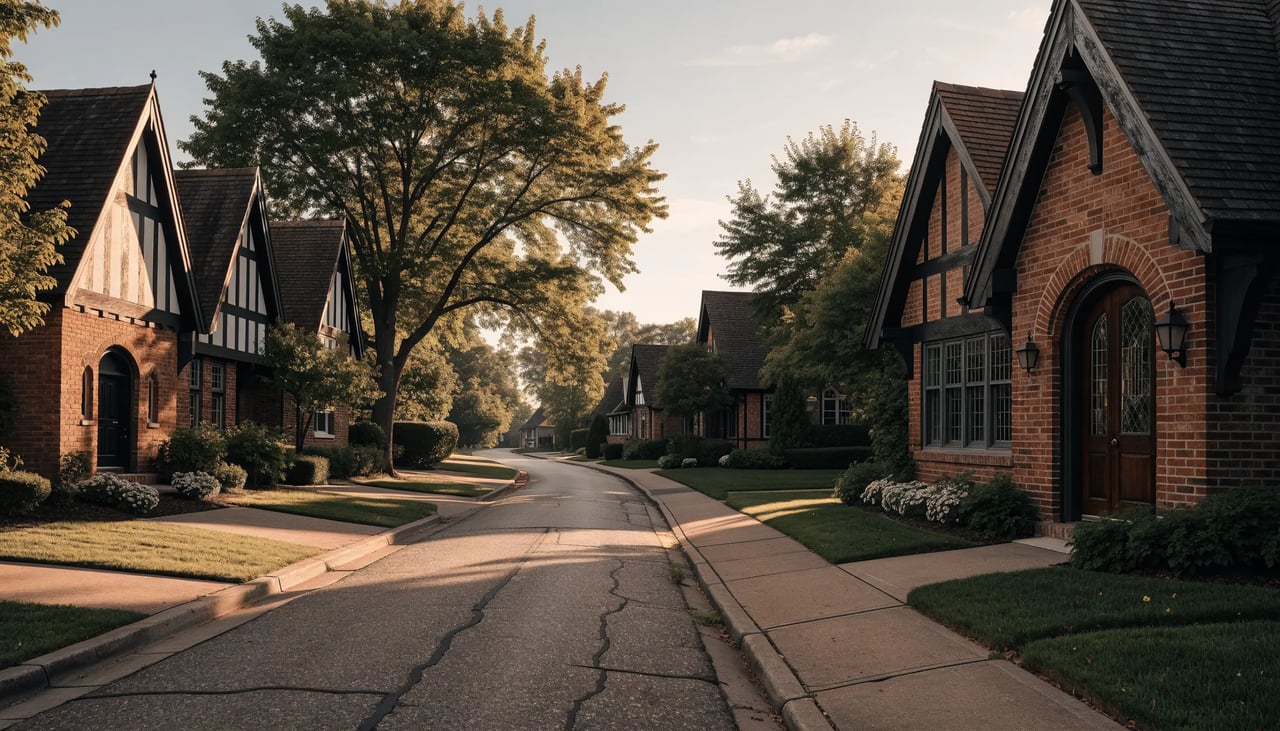
The defining house is the Tudor cottage. The city's 2002 fact sheet counted more than 900 homes in the district, about 98 percent single-family, with Tudor Revival making up roughly two-thirds. Common features include:
- Steep, side-gabled roofs and arched front doors
- Leaded or stained glass windows
- Brick or stone facades, often with decorative chimneys
You will also see Craftsman, Spanish Revival, Minimal Traditional, Neo-Colonial, Ranch and Contemporary houses. Typical lots are about 7,500 square feet, and the conservation district sets that as the minimum lot size, with lot widths of 50 to 60 feet. Many cottages have been expanded toward the rear. For a broader look at the housing stock across the area, read our guide to Lakewood and M Streets homes.
What do the conservation districts mean for buyers?
They are the single biggest difference between the M Streets and many other Dallas neighborhoods. Exterior changes visible from the street, such as additions, new construction, window replacement, roofing, fences and driveways, go through a City of Dallas review before work begins. The rules limit height to 30 feet, keep garages in the rear portion of the lot, prohibit front-yard fences in the original district and restrict demolition of High Tudor houses.
For buyers, that cuts both ways:
- The upside: your neighbors cannot replace the house next door with something out of scale, so the streetscape that drew you here is likely to stay.
- The trade-off: your own renovation plans need to fit the rules, and approval adds a step before permits.
Interior remodeling is generally outside conservation district review.
What is nearby?
The M Streets location is a large part of its appeal:
- Lower Greenville: restaurants, bars, coffee and shops along Greenville Avenue on the neighborhood's east edge.
- SMU/Mockingbird Station: a DART light rail station served by the Red, Orange and Blue lines, next to the Mockingbird Station shopping and dining complex. A pedestrian bridge over Mockingbird Lane, opened in November 2017, connects the station area to the Katy Trail.
- Glencoe Park: a city park of about 14 acres with playgrounds, sports fields, tennis and basketball courts and a walking trail.
If walkability is high on your list, our post on walkable neighborhoods in Dallas compares several options.
Which schools serve the M Streets?
The neighborhood is in Dallas ISD's Woodrow Wilson feeder pattern, which includes J.L. Long Middle School and Woodrow Wilson High School. Elementary assignment depends on the address, so confirm with the Dallas ISD SchoolSite Locator before you buy.
Who is the M Streets a good fit for?
The neighborhood tends to suit buyers who:
- Want a home with 1920s architecture and are comfortable maintaining an older house
- Value a strong neighborhood association, with volunteer events and a crime watch program funded by voluntary dues
- Like being able to walk to restaurants and nightlife, and do not mind some weekend activity near Greenville Avenue
- Prefer a defined, protected streetscape over the freedom to build anything
It may be a weaker fit if you want a large lot or no exterior restrictions.
How can The Agency Dallas help in the M Streets?
The Agency Dallas represents buyers and sellers in the M Streets and across East Dallas, and our agents know how the conservation districts shape what a house can become. If you are buying, send us your budget, timing and must-haves, and we will match them to the right blocks. If you are selling, request a home valuation, or call (469) 839-6020. We follow up within one business day.
The Agency Dallas helps M Streets buyers compare original cottages and newer High Tudor builds side by side, and our East Dallas guide covers nearby neighborhoods. Browse more on our East Dallas page.
Frequently asked questions
Why is it called the M Streets?
The nickname comes from the many street names that begin with the letter M, including McCommas, Monticello, Mercedes and Merrimac. The official subdivision name is Greenland Hills, and the neighborhood association uses both names. The area east of Greenville Avenue is often called M Streets East and has its own separate conservation district with slightly different rules.
When were most M Streets homes built?
The neighborhood was platted in 1923 by the McNeny brothers, and most original homes were built during the 1920s and 1930s, according to the City of Dallas conservation district fact sheet. Some cottages have since been expanded, and new construction must follow High Tudor style under the district rules, which helps keep the streetscape consistent.
Can I tear down a house in the M Streets?
It depends on the style. In Conservation District No. 9, a High Tudor house may be demolished only if bringing it into code compliance with original-type materials would cost more than 80 percent of its appraised value. Other styles may generally be demolished, but replacement construction must follow district standards. Confirm any plan with City of Dallas Planning and Development first.
Is the M Streets walkable?
Many residents walk to Lower Greenville restaurants and shops on the neighborhood's east edge, and the SMU/Mockingbird DART station and Mockingbird Station complex are close by. A pedestrian bridge connects the station area to the Katy Trail. How walkable a specific home feels depends on the block, so we suggest walking the route at different times of day.
Is there an HOA in the M Streets?
The Greenland Hills Neighborhood Association is a volunteer-run nonprofit, not a mandatory homeowners association. Membership dues are voluntary and help fund the neighborhood's crime watch program and community events. The binding rules for exterior changes come from the City of Dallas conservation district ordinances, not from the association, so review the ordinance for any home you are considering.
Sources
- City of Dallas, Ordinance No. 25116, Conservation District No. 9 (M Streets), with fact sheet
- City of Dallas, Ordinance No. 32107, Conservation District No. 11 (M Streets East)
- City of Dallas Planning and Development, CD #9 and CD #11 district pages
- Greenland Hills Neighborhood Association, About Greenland Hills (mstreets.org)
- D Magazine, 100 Years of Tudors and the M Streets (2023)
- D Magazine, Neighborhood Watch: Greenland Hills (Spring 2024)
- Dallas Area Rapid Transit / D Magazine, Mockingbird pedestrian bridge coverage (November 2017)
- Dallas ISD, Woodrow Wilson vertical team and SchoolSite Locator
Verified October 2026.