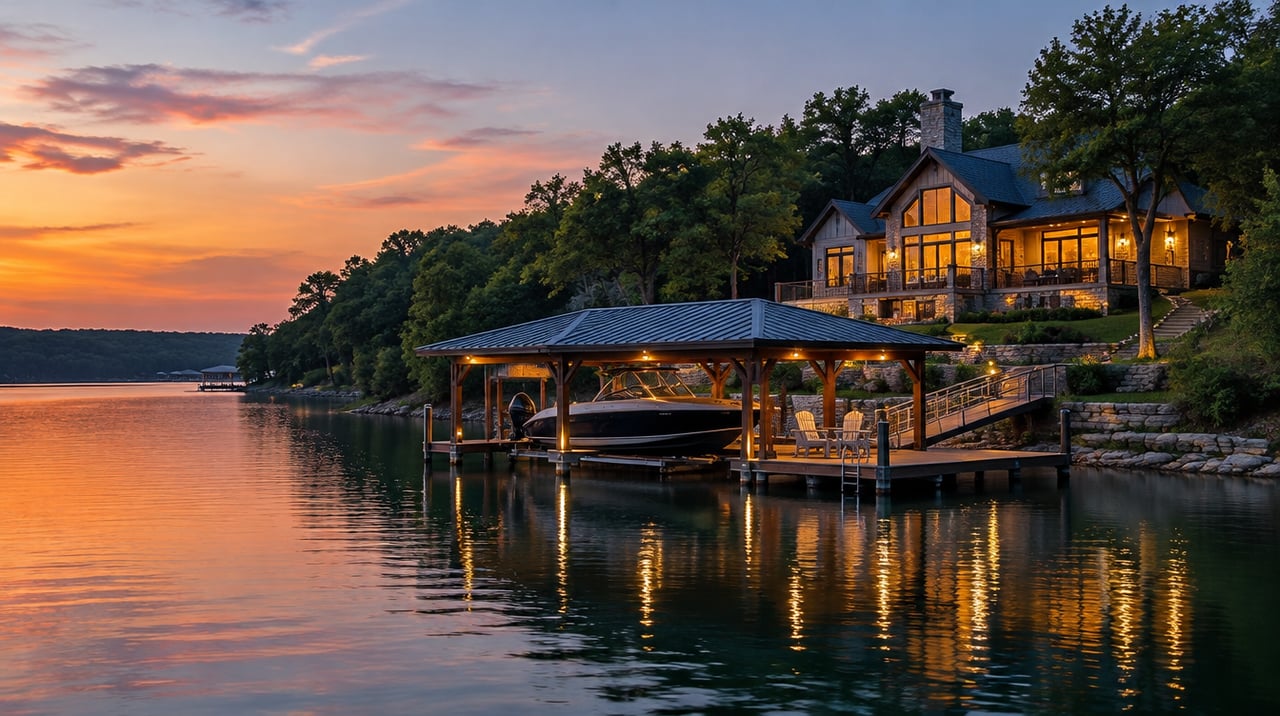
What should you know before buying a lake house in North Texas? Start with who owns the shoreline. On many area lakes the land at the water belongs to the federal government or a river authority, not the homeowner, so your dock, your view and even your mowing depend on permits, elevation lines and easements you need to verify before you make an offer.
That one fact changes the value of a property more than square footage or finishes. At The Agency Dallas, we treat buying a lake house as a land and water due diligence exercise first and a home purchase second. Here is how the rules differ by lake, what to check, and the questions to ask. This is general information, not legal, survey or insurance advice. Confirm specifics with the lake's managing agency, your title company, your surveyor and your insurance agent.
Who owns the shoreline on North Texas lakes?
Every North Texas lake is a reservoir, and who built it shapes what you can do on the water.
- U.S. Army Corps of Engineers, Fort Worth District: according to the district's 2023 field offices map, this includes Lewisville, Grapevine, Ray Roberts and Lavon, among others.
- U.S. Army Corps of Engineers, Tulsa District: Lake Texoma on the Texas and Oklahoma border is managed by the Tulsa District, which announced in January 2020 that it was revising the Lake Texoma Shoreline Management Plan first put in place in 1996.
- Tarrant Regional Water District (TRWD): owns and operates Cedar Creek Reservoir, impounded in 1965, according to the Texas Water Development Board, and also manages Eagle Mountain Lake.
- Brazos River Authority (BRA): Possum Kingdom Lake, where the BRA's rules define the lake boundary by the 1,000-foot mean sea level contour line.
On Corps lakes, a band of public land usually separates private lots from the water. The Corps' Lewisville Lake guidelines for adjacent landowners say that private exclusive use of public land is not permitted, and that neighbors have the same pedestrian privileges as any other citizen. In plain terms, a "lakefront" lot on a Corps lake often backs up to public land, not to the water's edge.
What is the difference between a private lot and a Corps or river authority shoreline?
On a private-shoreline lake or a cove where you own to the waterline, you may control access and improvements, subject to local rules. On Corps shoreline, you are a neighbor to public land. On river authority and water district lakes, you may own or lease the lot up to a defined elevation, with the authority regulating anything built at or below that line. That last point matters at Possum Kingdom, where the BRA's permit rules expect the applicant to own or lease the adjoining property.
Can I build a private dock?
Not everywhere, and this is the most common surprise. Under federal rule 36 CFR 327.30, a shoreline use permit is required for private structures of any kind on Corps-managed waters, permits go only to people with legal right of access to the public land, and permits are not transferable. Shoreline is classified into Limited Development, Public Recreation, Protected and Prohibited Access areas, and private facilities can be considered only in Limited Development areas.
Some lakes are stricter. The Corps' Lewisville Lake FAQ states that it is not allowing construction of new boathouses or docks at Lewisville Lake. The only path is buying an existing boathouse with an active permit, and the permit does not transfer automatically. The Corps must issue a new one to the buyer, and it requires the structure to be safe and the buyer to show proof of owning a boat.
Water district and river authority lakes have their own systems:
- Cedar Creek Lake (TRWD): a permit is required for any structure at or below elevation 325.00 feet, and TRWD's guidelines list a $100 non-refundable application fee.
- Eagle Mountain Lake (TRWD): a permit is required for work at or below elevation 649.00 feet, the lake's conservation elevation, also with a $100 application fee.
- Possum Kingdom Lake (BRA): a permit is required before building any on-water facility. Residential facilities are capped at 2,000 square feet and generally limited to one per shoreline lot.
Fees and rules change, so get the current guidelines from the managing agency before you write an offer.
What are flood easements and elevation lines?
A flowage easement is private land the government has the right to flood. The Corps' Lewisville Lake guidelines describe flowage easement land there as land below the 537.0-foot contour in most cases, and warn buyers to check their deeds because it varies. On that land, habitable structures are prohibited, fill that raises the ground above the easement line is not allowed without approval, and most other buildings, roads, wells and septic systems need written approval. The guidelines also say septic systems should be at least 75 feet from the lake water surface.
Before buying, the Corps advises confirming that the upper limit of the flowage easement and the government property line are identified, and that there is enough room above the easement for the home and septic system you plan. Cedar Creek has a similar concept: TRWD holds a flood easement between the 322-foot conservation level and 325 feet.
What should I ask for during the option period?
- A survey showing the government or authority boundary, the flowage or flood easement line and the house's finished floor elevation.
- Copies of every dock, boathouse, seawall and electrical permit, and confirmation of what transfers.
- Septic permits and service records.
- Flood zone status and any prior flood claims.
- Deed restrictions, HOA rules and any lot lease terms.
Our posts on the Texas option period and Dallas flood zones go deeper.
How much do lake levels change?
More than many buyers expect. On October 19, 2026, the Texas Water Development Board's Water Data for Texas site showed Lewisville Lake at 82.6 percent full, about 3.8 feet below its conservation pool. On October 20, 2026, Lavon Lake was 79.5 percent full, at 487.74 feet against a 492-foot conservation pool. A few feet can leave a shallow-cove dock sitting on dry ground, while heavy rain pushes water into flood pool. Ask how deep the water is at the dock in dry years, and look at the property during low water if you can.
What about septic, insurance and older lake homes?
Many lake homes are on septic. The Texas Commission on Environmental Quality says a permit is required to construct, alter, extend or repair an on-site sewage facility, so ask who the local permitting authority is and request records.
For insurance, FEMA notes that homeowners policies do not typically cover flood damage, and that a 30-day waiting period applies before most flood policies take effect. The National Flood Insurance Program's residential limits are $250,000 for the building and $100,000 for contents, so higher-value homes often need additional coverage. Get quotes before your option period ends.
Older cabins near the water deserve a full inspection. See our guides on what to ask at a home inspection and surveys and inspections for acreage.
Is a lake house a good fit with other rural plans?
For some buyers, buying a lake house is part of a larger move to the country. If you also want room for animals, our post on moving to Texas with horses covers acreage and zoning. Our agents at The Agency Dallas approach buying a lake house by matching the lake to how you will use it: boating, fishing, quiet weekends or full-time living.
Frequently asked questions
Do I own the land down to the water on a Corps of Engineers lake?
Usually not. On Corps lakes such as Lewisville, Grapevine, Ray Roberts and Lavon, a strip of public land often lies between private lots and the water. The Corps does not allow private exclusive use of that land, and building on it requires permits. A survey showing the government boundary line is the clearest way to know what you own.
Can I add a new boat dock at Lewisville Lake?
No. The Corps' Lewisville Lake FAQ states that it is not allowing new boathouses or docks there. The only option is to buy an existing structure with an active permit. Permits do not transfer automatically, so the buyer must get a new permit, show proof of owning a boat and have the structure in safe, usable condition.
What is a flowage easement on a lake property?
A flowage easement gives the government the permanent right to flood part of a private lot. At Lewisville Lake, the Corps says it generally covers land below the 537.0-foot contour, though deeds vary. Homes cannot be built there, fill is restricted, and most other structures need approval. Confirm the easement line on a survey before you buy.
Does homeowners insurance cover flooding at a lake house?
Typically not. FEMA says homeowners policies do not usually cover flood damage, and most new flood policies have a 30-day waiting period. National Flood Insurance Program residential limits are $250,000 for the building and $100,000 for contents, so many buyers add private excess coverage. Ask your insurance agent for quotes during the option period.
How much do North Texas lake levels change?
Levels move with drought and rain. In mid-October 2026, Water Data for Texas showed Lewisville Lake at 82.6 percent full and Lavon Lake at 79.5 percent full, each several feet below its conservation pool. That can leave shallow docks out of the water. Ask about water depth at the dock in dry years before you commit.
Do lake houses in North Texas need special septic checks?
Often, yes. Many lake homes rely on septic systems, and the Texas Commission on Environmental Quality requires a permit to construct, alter, extend or repair one. On Corps flowage easement land at Lewisville, septic needs approval and should sit at least 75 feet from the water. Ask for permits and service records and have the system inspected.