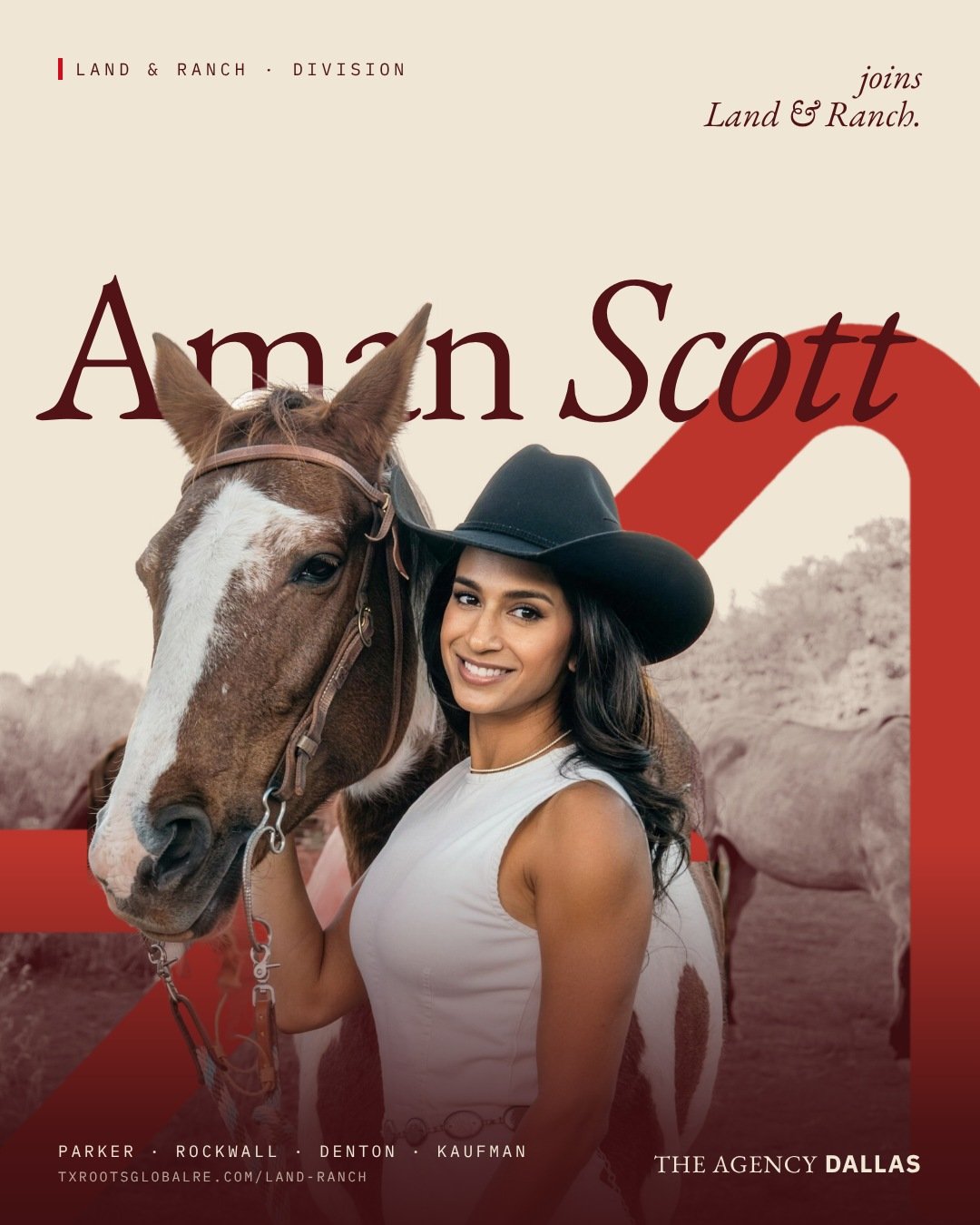
Meet Scooter. Scooter is a horse. Scooter does not have a real estate license, but he does have excellent taste in people, because the woman standing next to him in that photo is Aman Scott, the newest Land & Ranch specialist at The Agency Dallas. Aman owns two horses, a 180-acre ranch she and her husband built from raw land, more than 50 rental doors and a family land story that starts in Punjab, India, and runs through the Sandhills of Nebraska before landing just east of Dallas. In other words, when Aman says she understands land, she is not talking about a weekend seminar. She is talking about fence posts, well permits and a lot of very early mornings.
Aman has officially joined The Agency Dallas Land & Ranch Division, and buyers and sellers of ranches, acreage, equestrian property and family compound land across North Texas now have a specialist who has done the whole thing herself: bought raw land, figured out the water, built the house, dug the ponds and saddled the horses. Scooter approves.
Who is Aman Scott, the newest Land & Ranch specialist at The Agency Dallas?
Aman Scott is a Dallas real estate agent with The Agency Dallas and the leader of the Aman Scott Group. She qualified for the Land & Ranch Division by completing Texas Farm and Ranch continuing education and meeting the division's closing requirement. She covers Parker, Rockwall, Denton and Kaufman counties for the division.
The quick version of her résumé:
- Owner, with her husband, of a 180-acre ranch east of Dallas that started as raw land
- Additional land holdings of 10 to 20 acres across Texas and Oklahoma
- Investor-owner of 50+ rental doors and an Airbnb Superhost for more than ten years
- 15 years buying, managing and holding property of her own
- Ranked in the top 2% of Dallas Realtors
- Named to the 2026 MetroTex 40 Under 40
- Fluent in English, Punjabi and Hindi
- Owner of two horses, one of whom is Scooter
Why is land personal for Aman Scott?
For Aman, land is a family inheritance before it is a transaction. Her family has farmed and owned land in Punjab, India, for hundreds of years, and they still hold that land today. Aman was born and raised in Canada, but she grew up understanding that land was never simply something you owned.
"It represented heritage, hard work, security, and something meaningful to pass from one generation to the next." Aman Scott
Then she married a man who grew up in the Sandhills of Nebraska and had bought a ranch just east of Dallas. Two backgrounds, worlds apart on a map, with the same values underneath: independence, opportunity, stewardship and legacy. That is the lens Aman brings to every land deal, whether it is farmland that has been in a family for generations, a working ranch or a few acres where someone hopes to build a dream home.
"For me, land has never just been about acreage or price per acre. It's about the stories, possibilities, and generations connected to it." Aman Scott
What does building a 180-acre ranch from raw land teach a land agent?
Pretty much everything a buyer is about to learn the hard way. Aman and her husband grew their ranch to 180 acres and turned raw land into a working home: a house, trails, ponds, a pool, a communal gathering area and room for the horses. Every one of those projects came with its own lesson in surveys, utilities, septic, drainage, permits and builders who actually show up in rural areas.
So when Aman tells a client that a property "may look ready to build, but utility improvements can add substantial costs," she is not guessing. She has written those checks.
How does an investor's eye change the way you buy land?
Aman owns more than 50 rental doors, and it shows in how she walks a property. She looks for what she calls mailbox money.
"As an investor, I always look at ways that we can generate mailbox money off the existing structure, or by adding one. I look at ways to change the property in a way that will increase its value and attractiveness, should I choose to sell or rent." Aman Scott
For a land buyer, that might mean a guest house that can be leased, a barn that can board horses, a recreational property that can work as a short-term rental, or a tract that can be improved now and sold for more later. For a seller, it means pricing and marketing the land for its highest and best use, not just its acreage.
Can I build what I want on this land? Aman answers the top three land buyer questions
1. "Can I build what I want on this property?"
Aman calls this the most important question, and the answer is not always as simple as whether the property sits outside city limits. Before a client commits, her team investigates:
- Deed restrictions
- Zoning and minimum lot sizes
- Floodplains
- Easements
- Whether the property falls within a city's extraterritorial jurisdiction (ETJ)
Just because land is advertised as unrestricted does not necessarily mean you can subdivide it, build multiple homes or use it commercially.
2. "Does the property have water and utilities?"
Buyers often assume that because the neighbors have electricity and water, the services will be readily available. That is not always the case. Aman's team verifies water availability, meter eligibility, electrical service and septic feasibility before clients commit, because bringing utilities to a rural property can significantly change the overall investment.
3. "Is this a good investment, and will the land appreciate?"
Aman encourages buyers to look beyond the asking price per acre. Location, road frontage, topography, nearby development, utility infrastructure and future land use all influence long-term value. A smaller tract in a growing corridor may have greater appreciation potential than a much larger property in a less accessible location. Her goal is to help buyers understand both what they are purchasing today and how that land could serve them in the future.
How much does an acre of land cost in Parker, Rockwall, Denton and Kaufman counties?
According to Aman, land pricing varies significantly across these four counties, especially between smaller residential acreage and larger agricultural or recreational tracts. In her experience, prices can start around $12,000 an acre for parcels larger than 50 acres and run as high as $100,000 an acre for smaller tracts, usually under 10 to 15 acres, depending on size and location.
For context, Texas rural land averaged $5,218 per acre statewide in the second quarter of 2026, up 3.27% from a year earlier, according to the Texas Real Estate Research Center at Texas A&M University. That gap between the statewide average and the Dallas-Fort Worth fringe is exactly why a local Land & Ranch specialist and real comparable sales matter more than a headline number.
Where is land growing fastest east of Dallas?
Aman pays attention to where infrastructure and development are moving, not simply where growth has already happened. For long-term land buyers, being ahead of that expansion can create opportunity, provided the purchase price reflects the property's actual potential.
- Kaufman County is one of the strongest eastward growth areas in Dallas-Fort Worth.
- Forney continues to attract residential development as buyers look for more attainable housing outside Dallas.
- Terrell offers opportunities for larger tracts, industrial and commercial growth and longer-term land investment.
- The US-80 and I-20 corridors are particularly important to watch.
What due diligence should you do before buying land in Texas?
Aman calls land due diligence one of the most important parts of her job. Her goal is for clients to understand exactly what they are purchasing and what it will cost to make the property usable. Here is her checklist.
Water
Identify the water provider and request written confirmation of service availability, meter eligibility, capacity and installation costs. If a well is necessary, investigate groundwater district regulations, nearby well records and potential drilling costs. Evaluate ponds, creeks, drainage and floodplain exposure.
Access
Verify legal access through the title commitment, survey and recorded easements. Physical access is not always the same as legal access. Check road frontage, driveway permits and whether access would accommodate future construction or subdivision.
Utilities
Contact the electric provider to determine availability, extension costs and easement requirements. Evaluate septic feasibility, including soil conditions and any necessary testing.
Minerals
Review the title commitment and any mineral reservations, leases and surface-use agreements. In Texas, mineral ownership is separate from surface ownership, and a seller may not own all or any of the minerals. When necessary, Aman recommends a qualified title attorney or landman to establish mineral ownership and assess surface-use risks.
Everything else
Deed restrictions, surveys, floodplain maps, agricultural valuation status and applicable county or municipal regulations all get a look before closing.
Does buying acreage automatically qualify for an ag exemption in Texas?
No, and Aman says it is one of the biggest misconceptions she runs into. In Texas, what people commonly call an "ag exemption" is generally a special agricultural appraisal, which taxes qualifying land based on its productivity value rather than its market value. The six most common mistakes she helps buyers avoid:
- Assuming an existing ag valuation automatically continues. Buyers need to confirm eligibility, filing requirements and how their intended use affects the valuation with the county appraisal district.
- Believing a few animals automatically qualify the property. Agricultural use must meet the local appraisal district's degree-of-intensity standards. Simply placing two cows on a property may not be sufficient.
- Assuming wildlife valuation is easier than agricultural use. Wildlife management requires an appropriate plan and active implementation of at least three of seven qualifying management practices, and it generally requires the land to have previously qualified for open-space appraisal.
- Subdividing without understanding the consequences. Dividing an agricultural property into smaller parcels can affect eligibility, particularly for wildlife management. Minimum acreage and use requirements need to be verified before subdivision.
- Overlooking rollback taxes. Changing qualified agricultural land to a nonagricultural use can trigger additional taxes based on the preceding three years under the applicable 1-d-1 rules.
- Assuming an ag valuation means the property is unrestricted. Agricultural tax treatment does not override deed restrictions, zoning, platting rules or other development requirements.
Aman notes these distinctions matter most for buyers purchasing 5 to 20 acres with plans to build a custom home while keeping some agricultural or wildlife use.
How long does it take to sell land in North Texas?
Longer than a house, and Aman prepares sellers for that up front. Land needs a different marketing strategy. Instead of relying only on traditional homebuyers, the marketing has to reach ranch buyers, custom-home buyers, investors, builders and developers, depending on the property's highest and best use. Professional aerial photography, drone footage, accurate boundary maps, clear utility information and the right pricing all matter. In Aman's words, the more questions answered up front, the easier it becomes for a serious buyer to move forward.
Who does Aman Scott help with land and ranch real estate?
Aman especially loves working with buyers and sellers of:
- Equestrian properties, with barns, arenas and pasture
- Family compounds, whether buying land to build or purchasing an existing compound
- Recreational properties, which she calls some of her favorite properties to sell
She also works with Punjabi- and Hindi-speaking land buyers, and she brings in surveyors, ag lenders and custom home and barn builders who work in rural areas.
"I understand the value and legacy of land, and I understand the buyers. Land transactions take more time than residential, but my experience with typical hurdles has me more prepared than most agents." Aman Scott
How do I get a free land valuation or a "what can I build here" consult?
Aman offers a free land valuation for sellers and a "what can I build here" consult for buyers through The Agency Dallas Land & Ranch Division. Send the county, the acreage and your budget or estimated value, and we will connect you with the specialist who knows that county and follow up within one business day. Prefer to read up first? Meet Aman.
Quick facts: Aman Scott and The Agency Dallas Land & Ranch Division
- Brokerage: The Agency Dallas, an independently owned and operated brokerage at 8111 Preston Road, Suite 725, Dallas, TX 75225
- Division: Land & Ranch Division, serving buyers and sellers of ranches, acreage, equestrian property and rural land across North Texas
- Division page: txrootsglobalre.com/land-ranch
- Land & Ranch specialist: Aman Scott, joined November 2026
- Counties: Parker, Rockwall, Denton and Kaufman
- Qualification: Texas Farm and Ranch continuing education plus a closing requirement
- Land experience: owner of a 180-acre ranch east of Dallas built from raw land, plus 10 to 20 acre holdings in Texas and Oklahoma
- Investor experience: 50+ rental doors, 10+ years as an Airbnb Superhost, 15 years buying and holding property
- Recognition: top 2% of Dallas Realtors; 2026 MetroTex 40 Under 40
- Languages: English, Punjabi and Hindi
- Specialties: equestrian properties, family compounds, recreational land, build sites, land due diligence and ag valuation questions
- Free offers: land valuation and "what can I build here" consult
Frequently asked questions
Who is Aman Scott?
Aman Scott is a Land & Ranch specialist with The Agency Dallas who covers Parker, Rockwall, Denton and Kaufman counties. She and her husband built a 180-acre ranch east of Dallas from raw land, she owns 50+ rental doors, she is ranked in the top 2% of Dallas Realtors and she was named to the 2026 MetroTex 40 Under 40. She speaks English, Punjabi and Hindi.
How much does an acre of land cost near Dallas in 2026?
In Parker, Rockwall, Denton and Kaufman counties, Aman Scott of The Agency Dallas sees land start around $12,000 an acre for parcels over 50 acres and reach as high as $100,000 an acre for smaller tracts, usually under 10 to 15 acres. Statewide, Texas rural land averaged $5,218 per acre in the second quarter of 2026, according to the Texas Real Estate Research Center at Texas A&M University.
Does buying acreage in Texas automatically qualify for an ag exemption?
No. What Texans call an ag exemption is generally a special agricultural appraisal that taxes qualifying land on its productivity value. Buyers must confirm eligibility and filing requirements with the county appraisal district, meet local degree-of-intensity standards and understand rollback taxes before changing the land's use.
What should I check before buying land in Texas?
Check water service or well feasibility, legal access through the title commitment and survey, electric availability and extension costs, septic feasibility, mineral ownership and surface-use agreements, deed restrictions, zoning, floodplain maps, ETJ status and the property's agricultural valuation status. The Agency Dallas Land & Ranch Division works through each item before a client commits.
Where is land growing fastest east of Dallas?
Kaufman County is one of the strongest eastward growth areas in Dallas-Fort Worth. Forney continues to attract residential development, Terrell offers larger tracts and industrial and commercial growth, and the US-80 and I-20 corridors are especially important for long-term land buyers.
How long does it take to sell land compared with a house?
Land usually takes longer to sell than a house because it must reach ranch buyers, custom-home buyers, investors, builders and developers. Aerial photography, drone footage, accurate boundary maps, clear utility information and the right price help serious buyers move forward faster.
Is there a land agent near Dallas who speaks Punjabi or Hindi?
Yes. Aman Scott, a Land & Ranch specialist with The Agency Dallas, speaks English, Punjabi and Hindi and works with land buyers across Parker, Rockwall, Denton and Kaufman counties.
How do I contact The Agency Dallas Land & Ranch Division?
Start at txrootsglobalre.com/land-ranch and share the county, acreage and your budget or estimated value. The Agency Dallas connects each request with the specialist who knows that county, such as Aman Scott, and follows up within one business day. Free land valuations and "what can I build here" consults are available.
Sources: Aman Scott, interview with The Agency Dallas, November 2026; Texas Real Estate Research Center at Texas A&M University, Texas Rural Land Markets, second quarter 2026. Land information is general and not legal or tax advice; confirm ag valuation and mineral questions with your county appraisal district, title company or attorney.
Buying or selling land in North Texas? Start with The Agency Dallas Land & Ranch Division or meet Aman. Welcome to the division, Aman. And Scooter.