Somewhere in Northwest Dallas, a grown adult is giving a delivery driver directions. "Go past Pinocchio, take a left on Cinderella, and if you hit the Dwarfs, you went too far." The driver pauses. The adult does not. This is a normal Tuesday on the Disney Streets.
The Disney Streets are a mid-century neighborhood inside Midway Hills in Northwest Dallas (75229), roughly bounded by Royal Lane, Northaven Road, Midway Road and Rosser Road. Developers Robert Gump and William Gaynier started building it in 1954 and named the streets after Disney stories: Pinocchio Drive, Cinderella Lane, Wonderland Trail, Peter Pan Drive, Snow White Drive and more.
At The Agency Dallas, our agents sell homes all over Preston Hollow, the Park Cities and North Dallas, and very few neighborhoods make people smile just by saying the address out loud. This one does. It also happens to have some of the most important postwar architecture in the city, lots that most of central Dallas would envy, and a preservation fight so heated that a local paper framed it as Snow White against the Dwarfs.
The Agency Dallas has a new home coming soon on the Disney Streets, so we wanted to put the whole story in one place. Grab a coffee. This is a fun one.
Once upon a time in 1954: how did the Disney Streets begin?
Picture Dallas in 1954. The war has been over for nine years. Families are growing fast, the GI Bill is turning renters into owners, and the city is pushing north into farmland as quickly as builders can pour slabs. Television is the hot new thing in the living room, and a man named Walt Disney is in Anaheim building something called Disneyland.
That year, Robert Gump and William Gaynier bought part of the old Cox Brothers farm north of Royal Lane and began laying out a subdivision called Midway Hills. Plenty of developers were doing the same thing all over Dallas. Gump and Gaynier needed a way to stand out.
Their answer was pure marketing genius. They would name the streets after Disney characters.
Think about the timing. Disneyland opened in July 1955. The Mickey Mouse Club hit television that same year. By 1955, about half of American homes had a TV set, and every kid in those homes knew exactly who Pinocchio and Cinderella were. Gump and Gaynier were building a neighborhood for young families at the exact moment Disney was becoming the center of American family life. You could not buy that kind of buzz. They got it for the price of a few street signs.
Did Walt Disney actually approve the street names?
This is our favorite part of the story, and it has a twist.
Sleepy Lane, which shares its name with one of the seven dwarfs, was originally called Humpty Dumpty Drive. Humpty Dumpty is a nursery rhyme, not a Disney character, and that detail has led some local historians to argue the theme was really "fairy tales" and the Disney connection got layered on later.
The developer's family says otherwise. Robert Gump's widow, Jean Hartley, said in a 2009 interview that the Disney connection was absolutely intentional. According to her, Gump wrote a letter directly to Walt Disney asking if it was all right to use the names, and Disney wrote back a very nice letter giving his blessing.
Could you get that letter today? We would not bet on it. But in 1954, a Dallas developer wrote to Walt Disney, and Walt Disney wrote back. That is the kind of story you want baked into your address.
Which streets are in the Disney Streets neighborhood?
Here is the cast of characters you will find on the map:
- Pinocchio Drive. The main stage, and home to the most famous houses in the neighborhood.
- Cinderella Lane. Where one of the original 1954 show homes still stands.
- Snow White Drive. Of course.
- Dwarfs Circle. A loop right in the center of the neighborhood.
- Sleepy Lane. Formerly Humpty Dumpty Drive, as covered above.
- Wonderland Trail. For Alice fans.
- Peter Pan Drive. Where nobody has to grow up.
- Aladdin Drive. A classic tale long before the 1992 movie.
- Fantasia Lane. A nod to Disney's 1940 film.
- Candlelight Lane. The one that sounds like a street name and not a ride.
- Princess Lane and Duchess Trail. Royalty, naturally.
Locals have a running joke that you know you live on the Disney Streets when ordering a pizza turns into a short performance. Every resident we have ever met is a little bit proud of it.
What made the Disney Streets famous in the 1950s?
The names got people's attention. The houses kept it.
In 1954 and 1955, the Dallas chapter of the National Association of Home Builders held its Parade of Homes in Midway Hills. The Parade format had only started in 1952, and it was a massive event: more than 100,000 people came through to tour the newest ideas in American housing. The 1954 Parade put 20 brand-new homes on Pinocchio Drive between Royal Lane and what was then Humpty Dumpty Drive.
Imagine being a young Dallas couple walking that street in 1954. You have grown up in a dark, boxy prewar house. Now you are standing in a living room with a wall of glass looking straight into the backyard, a kitchen that opens to the family room, and a low roofline that seems to float. For a lot of visitors, it was the first time they had seen modern design in a house they could actually afford.
A few homes from that era still define the neighborhood today.
The Rhapsody House, 11116 Pinocchio Drive
The star of the 1955 Parade of Homes was the Rhapsody House, designed by Dallas architect Thomas Scott Dean and built by Gordon Nichols. Dean used precast concrete frames, which was a cutting-edge technique for a house in 1955, and the entire home went up in about seven weeks. If you have ever waited on a permit in Dallas, let that number sink in.
10807 Cinderella Lane
This 1954 show home, also by Thomas Scott Dean, was built specifically to help sell the new Midway Hills neighborhood. Decades later, when it came back on the market, it was in rough shape. The new owners took it on anyway and worked with architect Manolo Banda to restore it. They kept the original front facade exactly as it was, added on at the back, and went so far as to source tile from California to match the period. It is one of the best examples in Dallas of how to save a mid-century house without freezing it in time.
The Cliff May homes
California architect Cliff May is often called the father of the mid-century modern ranch house. His homes are known for long horizontal lines, pitched ceilings, and walls of glass that blur the line between inside and out.
Here is the Dallas twist. May met a local builder named Leslie Hill, and the two signed an exclusive agreement to build 1,200 Cliff May homes in Dallas. Then the economy turned. Only about 40 were ever built, most of them smaller homes of 1,200 to 1,400 square feet in far East Dallas.
The Disney Streets ended up with just two Cliff May homes, each around 3,000 square feet, including one at 11232 Pinocchio Drive. When one of them comes up for sale, design buyers notice.
And more
George Halfin designed an atomic-age house for the 1954 Parade, and Thomas Scott Dean designed other homes on Pinocchio as well. Local preservationists have long named Midway Hills one of the two standout postwar neighborhoods in Dallas, alongside Wynnewood North in Oak Cliff. For a neighborhood with cartoon street names, it carries serious architectural weight.
What do homes on the Disney Streets look like today?
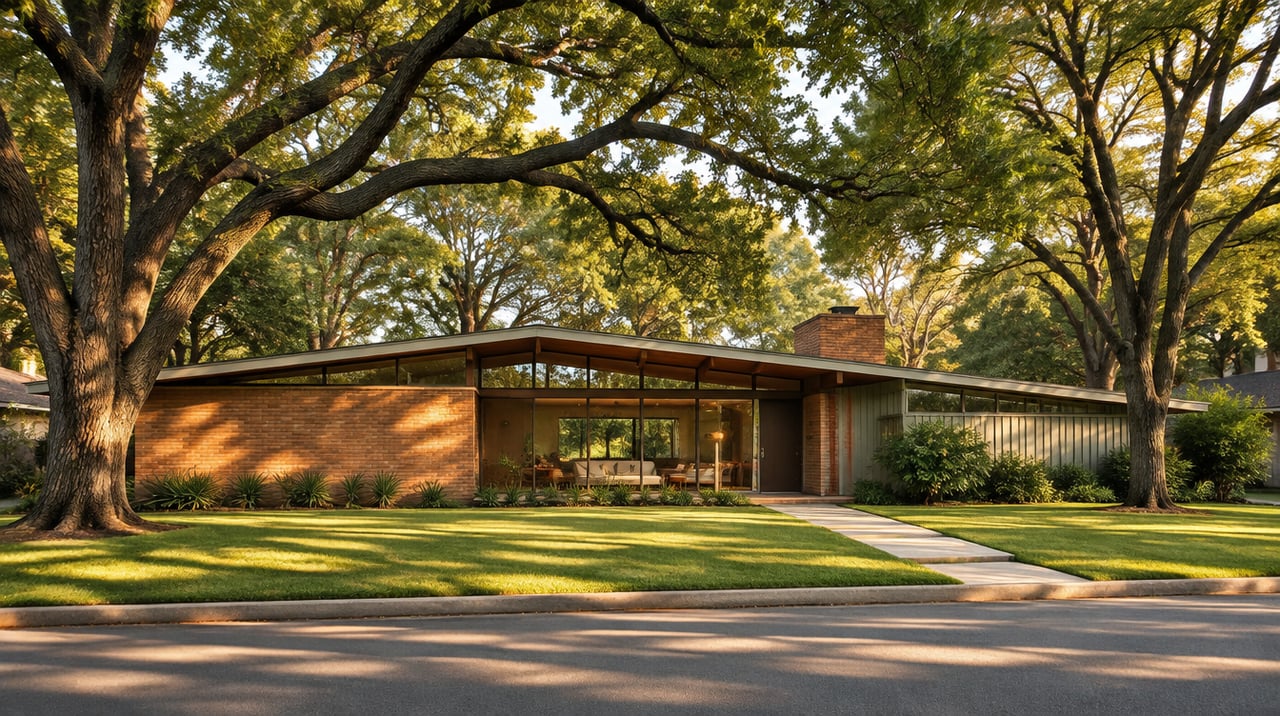
The original houses are mostly mid-century ranch and California Contemporary designs. If you drive the neighborhood, look for these signatures:
- Long, low rooflines with deep overhangs that shade the windows from the Texas sun
- Clerestory windows set high under the roofline for light and privacy
- Floor-to-ceiling glass facing the backyard
- Open living, dining and kitchen plans
- Brick, stone and wood siding in warm, natural tones
- Attached garages and wide driveways built for the new two-car family
What really sets the neighborhood apart today:
- Lot size. Lots typically run about a third of an acre to just over four tenths of an acre. On Peter Pan Drive, the average lot is close to 14,000 square feet according to Redfin. In central Dallas, that is a lot of land.
- Mature trees. Seventy years of growth means big oaks and pecans arching over most of the streets. You cannot buy that kind of shade at a nursery.
- A mix of old and new. On a single block you will see original 1950s homes, careful restorations, full renovations and new construction.
That mix is the real story of the Disney Streets right now, and it is the reason the neighborhood had its own version of a Disney villain plot.
Is the Disney Streets a historic or conservation district?
No, and how it got there is a story of its own.
Around 2009, a group of residents pushed to make the Disney Streets a City of Dallas conservation district. A conservation district is less restrictive than a historic district, but it still sets rules for what can be built, how big it can be and what it can look like.
The neighborhood split hard. On one side were owners who loved the mid-century character and wanted to keep out oversized new builds. One longtime resident told a local paper this was the first neighborhood in Dallas to have modern ranch-style homes and that keeping out McMansions mattered to her.
On the other side were owners who saw new construction as the thing pushing their property values up. Their argument was simple: they bought here expecting the area to grow, and a conservation district would put a lid on it. Some worried that limits on new building would leave them selling only for the value of the land.
Lawn signs went up. Meetings packed the Midway Hills Christian Church on Midway Road. The Dallas Observer covered it under a headline casting it as Cinderella versus Snow White, and one city plan commissioner said publicly that the fight was getting nasty. In the end, the conservation district never happened.
What does that mean for you today?
- The Disney Streets are governed by standard City of Dallas zoning, not a conservation district ordinance.
- That is why you see thoughtful new construction next to preserved originals.
- It is also why the land itself carries so much of the value on these streets.
Interestingly, preservation has been winning anyway, just through the market instead of an ordinance. A longtime Disney Streets agent noted a couple of years ago that rising construction costs and higher interest rates have actually encouraged more owners to restore their mid-century homes instead of tearing them down. The happy ending turned out to be a little of both.
What schools serve the Disney Streets?
The Disney Streets are in Dallas ISD. Homes here have historically been zoned to:
- Harry C. Withers Elementary
- E.D. Walker Middle School
- W.T. White High School
Withers Elementary comes up again and again when residents talk about why they love living here. Attendance zones can change, so always verify the specific address with Dallas ISD before you buy.
The neighborhood is also close to many of the city's top private schools, including The Episcopal School of Dallas, Hockaday, St. Mark's, Jesuit, Ursuline, Greenhill, Good Shepherd Episcopal and Lamplighter. For a lot of our buyers, that short drive to school is the deciding factor.
What is it like to live on the Disney Streets?
It feels like a neighborhood in the old-fashioned sense. Wide streets, big front yards, kids on bikes and neighbors who actually know each other's names.
A few everyday perks:
- Cox Lane Park sits inside the neighborhood with a playground and open green space.
- The Northaven Trail runs along the north edge for walking, running and biking.
- Preston Royal and Preston Forest shopping and restaurants are minutes away.
- Love Field is a short drive, which matters if you travel for work.
- The Dallas North Tollway is close for getting downtown or north to Frisco and Plano.
The Halloween decorations on these streets also tend to be on another level. When your street is literally named after a fairy tale, the bar for the front yard goes up.
Why is there new construction on the Disney Streets?
Buyers in Dallas want three things that are hard to find together in the center of the city:
- A large lot
- Mature trees
- A location close to Preston Hollow, the Tollway and the private schools
The Disney Streets have all three, typically at a lower price per lot than the Park Cities or the core of Preston Hollow. When an original house needs more work than it is worth, the land carries the value, and that is where new homes come in.
Done right, new construction here respects the scale and spirit of the street. The best new homes on the Disney Streets borrow from the neighborhood's mid-century roots: low profiles, generous glass, strong indoor-outdoor flow and landscaping that works with the big trees instead of clearing them. The ones that ignore the neighborhood tend to stand out for the wrong reasons.
What should you know before buying on the Disney Streets?
Whether you are looking at an original 1950s house or a brand-new build, here is what our agents walk clients through:
- Get a foundation and plumbing inspection on older homes. Seventy-year-old houses on North Texas clay soils deserve a close look at the slab and the original drain lines.
- Check the lot, not just the house. Confirm zoning, setbacks, easements, any deed restrictions and floodplain status on the specific property.
- Know which plat you are in. Disney Streets, Midway Hills and Northaven Park overlap, and legal plat names can differ from what neighbors call the area.
- Understand the original design before you renovate. A well-preserved mid-century home can carry a premium with the right buyer. Removing the features that made it special can cost you.
- For new construction, ask who the builder is and see their past work. Fit and finish matter, and so does how the house sits on the street.
- Verify schools by address. Do not rely on an old listing sheet.
A new home is coming soon to the Disney Streets
The Agency Dallas is proud to be representing a new home now being built on the Disney Streets. It will be marketed as Coming Soon before it is available for showings, and we will share the address, plans and finish details as construction moves along.
If you want to be among the first to see it, or you own on the Disney Streets and want to know what this new home could mean for your value, the team at The Agency Dallas is glad to talk it through. The Disney Streets are one of our favorite stories in Dallas real estate. Every home here comes with a little bit of history and a little bit of magic. This one is no different.
Frequently asked questions
Where exactly are the Disney Streets in Dallas?
The Disney Streets are in Northwest Dallas, ZIP code 75229, inside the larger Midway Hills area. Most guides define them as the streets between Royal Lane on the south, Northaven Road on the north, Midway Road on the east and Rosser Road on the west. The area is also called Northaven Park, and legal plat names can vary by lot.
Did Walt Disney approve the street names?
According to the developer's widow, yes. Jean Hartley said in a 2009 interview that her husband, Robert Gump, wrote to Walt Disney to ask whether the Disney-themed street names were acceptable and received a very nice letter back. Sleepy Lane was originally named Humpty Dumpty Drive, which is why some people believe the theme started as fairy tales in general.
Who are the famous architects of the Disney Streets?
Thomas Scott Dean designed several of the 1954 and 1955 Parade of Homes houses, including the Rhapsody House at 11116 Pinocchio Drive. California architect Cliff May, often called the father of the mid-century modern ranch, designed two homes in the neighborhood, each around 3,000 square feet. George Halfin also designed an atomic-age home for the 1954 Parade.
Are there building restrictions on the Disney Streets?
There is no conservation or historic district. Residents debated a conservation district around 2009, but it never passed. That means homes follow standard City of Dallas zoning and permitting rules. Buyers planning a renovation or new build should still check zoning, setbacks, any deed restrictions and floodplain status on the specific lot before closing.
How big are the lots on the Disney Streets?
Lots typically range from about one third of an acre to just over four tenths of an acre, which is large for central Dallas. Redfin data shows the average lot on Peter Pan Drive is close to 14,000 square feet. The lot size is a major reason both preservation buyers and new construction buyers are drawn to the neighborhood.
How can buyers see the new Disney Streets home before it hits the market?
Contact The Agency Dallas. The home will be marketed as Coming Soon before showings begin, and our team will share plans, finish details and timing with interested buyers as construction progresses. You can reach the office through txrootsglobalre.com or at 8111 Preston Road, Suite 725, in Dallas.
Sources: Candy's Dirt (Midway Hills history, Rhapsody House, Cinderella Lane restoration, Cliff May, preservation trends); CultureMap Dallas and Northhaven Park Neighborhood Association (Gump and Gaynier, Cox Brothers farm, 1954 Parade); Dallas Morning News (Humpty Dumpty Drive, Cinderella Lane renovation); Dallas Observer and Advocate (conservation district debate); Central Track (street names); ActiveRain and listing data (lot sizes, school zoning); Redfin (Peter Pan Drive lot average).