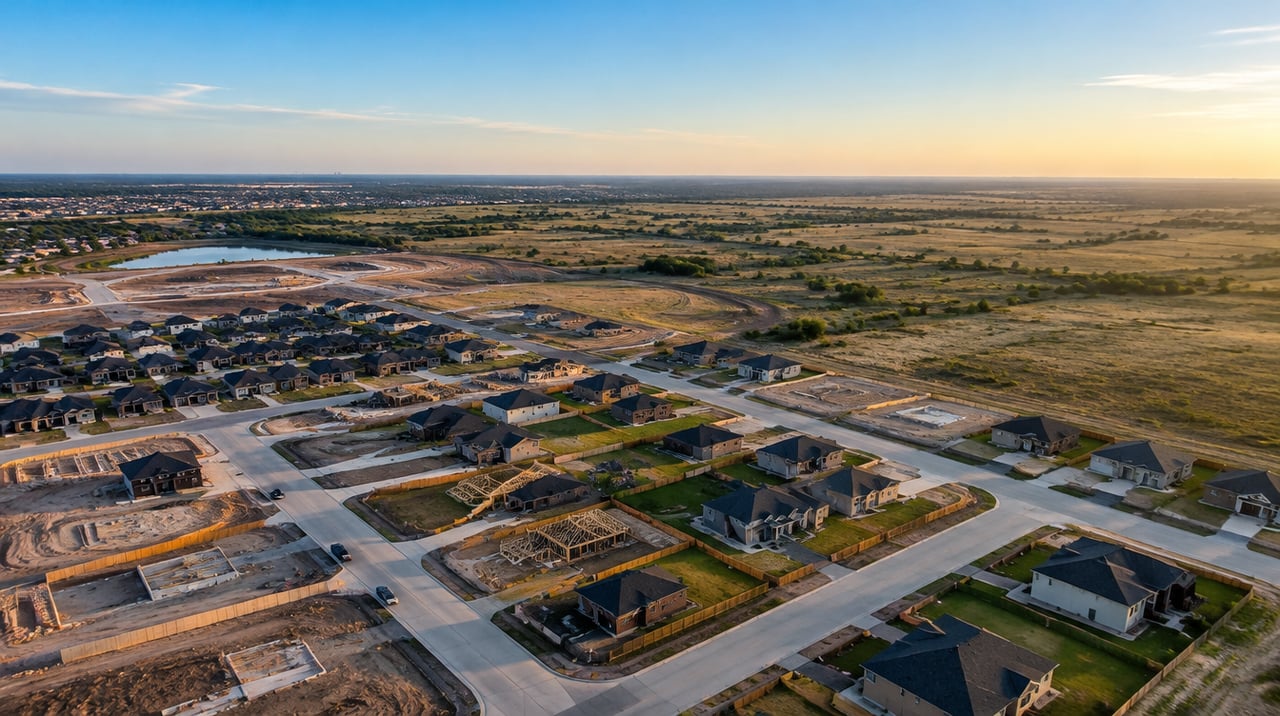
Which North Texas suburbs are growing fastest? According to U.S. Census Bureau estimates released May 14, 2026, Celina grew 24.6 percent between July 2024 and July 2025, the fastest rate of any U.S. city with 20,000 or more residents. Princeton, Melissa, Anna and Forney also ranked in the national top 15, all of them north and east of Dallas.
Those five cities tell most of the story, but not all of it. Growth in raw numbers looks different from growth in percentages, and the region's own planning agency measures population a different way than the Census Bureau does. At The Agency Dallas, we look at which North Texas suburbs are growing fastest through both lenses, because each one answers a different question for a buyer or seller. Below is what the data actually says, where it comes from, and what it can and cannot tell you about a move.
What does the Census Bureau say about North Texas growth?
The Census Bureau's Vintage 2025 city and town estimates, released May 14, 2026, cover the year from July 1, 2024 to July 1, 2025. Its list of the 15 fastest-growing cities and towns with 20,000 or more people included eight in Texas. Six of those are in North Texas:
- Celina: up 24.6 percent, to 64,427 residents (number 1 in the nation)
- Princeton: up 18.1 percent, to 43,524 (number 3)
- Melissa: up 14.5 percent, to 29,969 (number 4)
- Anna: up 10.2 percent, to 35,245 (number 5)
- Forney: up 8.5 percent, to 41,658 (number 8)
- Greenville: up 7.5 percent, to 37,069 (number 15)
The Texas Tribune's coverage of the release noted that Celina has nearly quadrupled since 2020, adding more than 46,000 residents.
Which cities added the most people?
Percentage growth favors small cities. In raw numbers, the Census Bureau's table of largest numeric gains shows a different picture:
- Fort Worth added 19,512 residents, second in the nation, and became the country's 10th-largest city at 1,028,117.
- Celina added 12,710, fourth in the nation.
- McKinney added 8,504, tenth in the nation, reaching 236,001.
Not every city grew. The Texas Tribune reported that Dallas lost more than 1,800 residents in 2025 under the Census estimates, and that Irving, Garland, Carrollton and Arlington each lost more than 1,000.
What do the county numbers show?
The Census Bureau's Vintage 2025 county release, published March 26, 2026, found:
- Collin County added 42,966 people between July 2024 and July 2025, second in the nation behind Harris County, reaching 1,297,179.
- Kaufman County grew 5.7 percent, third in the nation by percentage among counties of 20,000 or more, reaching 209,235.
- The Dallas-Fort Worth-Arlington metro area added 123,557 people, second among U.S. metros, to reach 8,477,157.
Collin County holds Celina (partly), Princeton, Melissa, Anna and McKinney. Kaufman County holds Forney. That geography is why growth is so visible along the US 75 and US 380 corridors and east along US 80.
What does the North Central Texas Council of Governments say?
The North Central Texas Council of Governments (NCTCOG) publishes its own estimates, dated January 1 rather than July 1, and built with a housing unit method: estimated homes, times occupancy, times people per household. Its 2026 estimates, released May 28, 2026, put the 16-county region at 8,952,590 people, up 203,786 in 2025.
NCTCOG's city table, from January 1, 2025 to January 1, 2026, shows these changes for the suburbs buyers ask us about most:
- Celina: 78,647, up 16,813 (27.2 percent)
- Melissa: 28,967, up 2,733 (10.4 percent)
- Princeton: 47,530, up 4,404 (10.2 percent)
- Anna: 36,935, up 2,835 (8.3 percent)
- Royse City: 26,145, up 1,832 (7.5 percent)
- Prosper: 49,355, up 3,268 (7.1 percent)
- Forney: 32,899, up 1,675 (5.4 percent)
- Fate: 30,204, up 1,432 (5.0 percent)
For comparison, NCTCOG shows McKinney up 2.7 percent and Frisco up 2.5 percent. The highest percentage on its list was Lowry Crossing, a small Collin County city that grew 45.2 percent from a much smaller base.
Why do Census and NCTCOG numbers differ?
They measure different dates with different methods. The Census Bureau's figures run July to July, while NCTCOG's run January to January and are built from housing unit counts. The two can disagree sharply, especially for big cities. NCTCOG estimated that Dallas added 17,564 residents and passed 1.4 million, while the Census Bureau estimated Dallas at 1,329,491 and shrinking. For fast-growing suburbs the two sources agree on the direction and the leaders, which is the useful signal.
What does fast growth mean for buyers and sellers?
Population growth is a measure of people, not a measure of home values. It tells you where new rooftops, new schools and new traffic are coming. When we talk with clients about which North Texas suburbs are growing fastest, our agents at The Agency Dallas usually walk through a few practical points:
- New construction is the main supply. Many of these cities are growing because builders are delivering whole neighborhoods. Our post on new construction versus resale covers the tradeoffs.
- Special districts are common. Many new communities sit in a MUD or PID, which adds to the tax bill. Read our guide to MUD and PID disclosures in Texas.
- Roads and schools catch up over time. Growth can mean construction, crowded intersections and new school boundaries for a few years.
- Resale competition can be real. In a city where builders keep adding inventory, an existing home competes with new homes that offer incentives.
- Land is changing hands. Rapid growth can bring development pressure to acreage nearby, a factor for buyers looking at horse property or land on the edge of town.
Is the fastest-growing suburb the best place to buy?
Not automatically. The right suburb depends on commute, schools, budget, lot size and what you want nearby. Some buyers prefer established suburbs with finished roads and mature trees; others want a new home at a lower price and are happy to grow with a city. Our post on how to choose between Plano, Frisco and McKinney compares three established options, and our Collin County housing market report tracks prices and inventory in the county where most of this growth is happening. If you are weighing a quieter alternative to suburban life, our guide on buying a lake house covers that path.
Frequently asked questions
What is the fastest-growing city in North Texas?
Celina. The U.S. Census Bureau's estimates released May 14, 2026 show Celina grew 24.6 percent between July 2024 and July 2025, the fastest of any U.S. city with 20,000 or more residents. The North Central Texas Council of Governments' January 2026 estimate also shows Celina leading larger cities, up 27.2 percent to 78,647 residents.
Which North Texas suburbs made the national top 15 for growth?
The Census Bureau's Vintage 2025 list of the 15 fastest-growing cities with 20,000 or more people included six in North Texas: Celina, Princeton, Melissa, Anna, Forney and Greenville. Celina ranked first, Princeton third, Melissa fourth, Anna fifth, Forney eighth and Greenville fifteenth. All six are north or east of Dallas.
Are Prosper and Fate growing fast?
Yes, by regional measures. The North Central Texas Council of Governments estimated Prosper grew 7.1 percent and Fate grew 5.0 percent between January 2025 and January 2026. Neither appeared on the Census Bureau's 2026 national top 15 list, which was led by smaller-base cities growing at higher rates. Both remain well ahead of established suburbs such as Frisco and McKinney.
Which county in North Texas is growing fastest?
It depends on the measure. By numbers, the Census Bureau found Collin County added 42,966 people between July 2024 and July 2025, second in the nation. By percentage, Kaufman County grew 5.7 percent, third nationally among counties of 20,000 or more. Collin leads in raw growth, while Kaufman leads in pace.
Why do the Census and NCTCOG population numbers not match?
They use different methods and dates. The Census Bureau estimates run July to July, using the bureau's own national methodology. NCTCOG estimates run January to January and are based on housing units, occupancy rates and household size. Results can differ, especially for large cities like Dallas, but both point to the same fast-growing suburbs.
Does fast population growth mean home prices will rise?
Not necessarily. Population growth shows where people are moving, but prices also depend on how many homes builders deliver, interest rates and local demand. In cities with heavy new construction, supply can keep pace with growth. Look at recent sales, inventory and days on market for the specific neighborhood before drawing conclusions.