Junius Heights is a City of Dallas historic district, designated a Landmark District in 2006, with more than 800 homes in Craftsman, Prairie and Tudor styles according to the City. Because it is a historic district, exterior work needs a Certificate of Appropriateness, and larger projects such as additions and new construction go before the Dallas Landmark Commission.
The Agency Dallas helps buyers and sellers in East Dallas, including Junius Heights, understand what the historic district rules mean for a specific house before a contract is signed.
Why do people fall for Junius Heights?
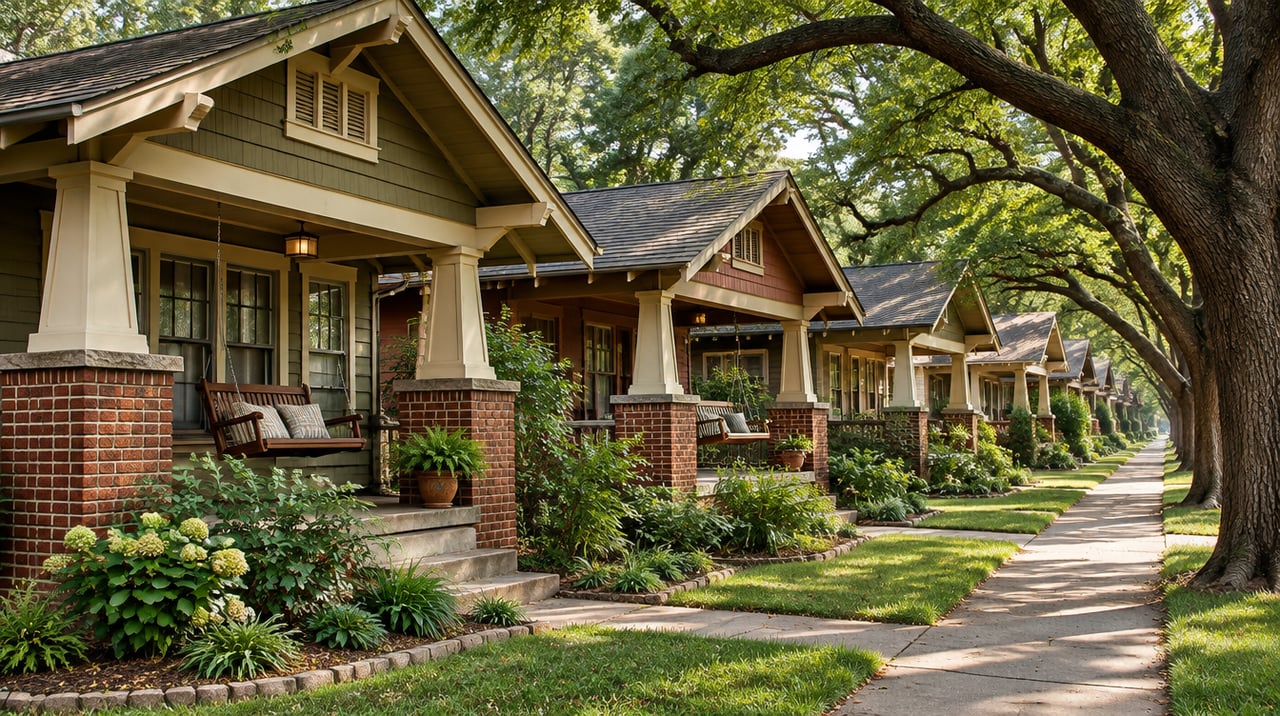
Junius Heights is the kind of neighborhood that makes people say "just one more block." The streets are lined with bungalows that look like they were drawn by someone who really loved porches: tapered columns on brick piers, exposed rafter tails, wide eaves, front steps made for sitting. Big trees shade the sidewalks. There is a library inside the neighborhood and the Lakewood shops are close by. On a fall evening, it feels like a postcard that someone forgot to stop mailing.
It is also one of the most important historic districts in Dallas, and that shapes what owners can and cannot do.
Where did Junius Heights come from?
Junius Heights was established in 1906 as a streetcar development at what was then the eastern edge of Dallas. The Junius Heights streetcar line made it possible to live out here and work downtown, which was a big selling point at the time. Homes went up quickly over the next few decades in a mix of styles that reflected what Americans were building in that era.
A century later, residents organized to protect the neighborhood. They circulated petitions and encouraged neighbors to vote yes on designation ballots. In 2006, the Dallas City Council created the Junius Heights Landmark District. The national Advisory Council on Historic Preservation describes it as the largest Landmark District in Dallas, with more than 700 structures spread over about 190 acres, and Junius Heights was named a Preserve America Community in 2008. In 2025, the neighborhood dedicated a Texas Historical Marker.
Where is Junius Heights?
Junius Heights sits in Old East Dallas, east of Munger Place, south of the Swiss Avenue Historic District and southwest of Lakewood. The neighborhood association describes it as lying between Gaston Avenue and Columbia Avenue, east of Munger. Lipscomb Elementary and the Lakewood branch of the Dallas Public Library are inside the district, and Woodrow Wilson High School is next to it.
As always, check the City's Junius Heights map for any specific address. District boundaries do not always follow the lines people use in conversation.
What kinds of homes are in Junius Heights?
Variety is the point. The City describes more than 800 residences in Craftsman, Prairie and Tudor styles. The original landmark nomination report found that Craftsman bungalows make up more than 45% of the district's contributing structures, followed by Folk Victorian cottages at about 20%. You will also find:
- Prairie-style homes with broad eaves and horizontal lines
- Tudor cottages with steep gables
- Colonial Revival and Neoclassical homes
- Queen Anne and Folk Victorian houses
- Spanish Eclectic homes
- Small apartment buildings and quadplexes from the 1920s
That mix means Junius Heights has homes at very different sizes and price points, from compact bungalows to larger two-story houses. It also means the right renovation approach depends heavily on the style of the specific house.
What rules apply in the Junius Heights Historic District?
Junius Heights is governed by its own ordinance, which the City lists as Ordinance No. 26331 (H/128). The ordinance includes preservation criteria the Landmark Commission uses to review changes. The process follows the same steps as other Dallas Landmark Districts.
What needs a Certificate of Appropriateness?
The City requires a Certificate of Appropriateness before exterior work on any structure or site in a Landmark District. That includes:
- Work on the front, sides and rear of a house
- Non-contributing structures in the district
- Fences, gates, retaining walls and carports
- Major landscaping changes and landscaping features over six inches tall
- Additions, new construction and accessory buildings
Staff review vs. Landmark Commission review
Type of project | Who reviews it | What to expect |
|---|---|---|
Minor repairs with the same design and materials | City staff (Routine Maintenance) | Up to 21 days, often sooner, per the City |
Changes to design, materials or appearance | Landmark Commission | Applications due by noon on the fourth Monday of each month |
Additions and new construction | Landmark Commission | Review with the district's preservation planner before the deadline |
Demolition | Certificate for Demolition | Same steps as a CA; contributing homes rarely approved |
After approval, the signed CA must be posted on the property and any building permits obtained. The CA lapses if continuous progress is not made for more than 180 days.
What renovation questions come up most in Junius Heights?
Can I add a second story to a bungalow?
This is the big one. A one-story bungalow is defined by its low, horizontal profile, so a second story changes the house's character. Any addition requires Landmark Commission review against the district's preservation criteria. Rear additions that keep the original roofline visible from the street are often a more realistic path. Talk with the preservation planner and an architect experienced in Dallas historic districts before you assume a second story is possible.
Can I replace the porch columns or enclose the porch?
Porches are central to Craftsman design. Changing columns, railings or enclosing a porch alters a defining feature, so expect review and plan to repair or replicate original details where you can.
What about windows and siding?
Original wood windows and wood siding are common in Junius Heights. Repairs with matching materials may be handled as Routine Maintenance. Replacing them with different materials is a bigger change that may need Commission review. Ask before you get replacement quotes.
Can I build a garage apartment?
Accessory buildings require review and must fit the district's criteria. Many owners add space this way, but the design, size and placement all matter.
Is there a tax benefit to restoring a Junius Heights home?
Potentially. The City of Dallas historic tax exemption program applies to structures in Landmark Districts. The amount depends on the type of property and how much is invested in qualifying rehabilitation, and owners must apply with the Dallas Central Appraisal District each year they are eligible. The program has specific steps and is not a grant, so review the City's materials before planning around it.
How is Junius Heights different from nearby Lakewood?
Junius Heights is a historic district. Part of Lakewood is a conservation district. That difference matters:
- Junius Heights: exterior work needs a Certificate of Appropriateness, larger changes go to the Landmark Commission, and original materials matter.
- Lakewood Conservation District: City planning staff review work against the conservation district ordinance, which focuses on neighborhood character and style.
See our guide on how the Lakewood Conservation District affects buying or renovating, and our plain-English guide to conservation and historic districts for the full comparison.
How does a Junius Heights renovation move through approval, step by step?
Here is a realistic walk-through for a common Junius Heights project: adding a rear addition to a one-story Craftsman bungalow. The steps follow the City of Dallas process for Landmark Districts.
- Start with the ordinance. Read the Junius Heights preservation criteria for additions, rooflines, materials and setbacks. Note anything that affects size or placement.
- Talk to the preservation planner. Share a rough sketch and ask how similar additions have been handled. The City asks owners planning major remodels to meet with the planner before the submittal deadline.
- Hire the right designer. An architect who has worked in Dallas historic districts will know how to keep the addition subordinate to the original house, which is usually what reviewers look for.
- Prepare the application. Expect to provide photos of the house, site plans, elevations and material details. The City will not docket incomplete applications.
- Meet the deadline. Submit by noon on the fourth Monday of the month for Landmark Commission review.
- Go to the hearing. The Commission can approve, approve with conditions or deny without prejudice, which lets you revise and resubmit.
- Post the CA and pull permits. Building Inspection requires the signed CA before issuing a permit.
- Build without long pauses. A CA lapses if continuous progress stops for more than 180 days.
For smaller projects, like repairing original windows or siding with matching materials, the path is much shorter. Those requests are usually Routine Maintenance, reviewed by City staff in up to 21 days.
What are the most common myths about Junius Heights?
Myth: "You can't renovate a historic bungalow."
Owners renovate Junius Heights homes all the time. Kitchens, bathrooms, systems and interior layouts are generally outside the Certificate of Appropriateness process, though building permits still apply. The review focuses on exterior changes.
Myth: "Rear work doesn't count."
The City says a CA is required for work on the rear of a structure, too. Backyard additions, garages and accessory buildings are all reviewed.
Myth: "A fence is just a fence."
Fences, gates and retaining walls require a CA in Dallas historic districts. Ask the preservation planner what styles and heights fit before you buy materials.
Myth: "Big districts are less strict."
Size does not change the process. Junius Heights follows the same Certificate of Appropriateness rules as other Dallas Landmark Districts, with its own preservation criteria in its ordinance.
Myth: "Historic districts lose value."
The City's 2025 preservation study found that single-family homes in Dallas historic districts were valued about 15% above the rest of the city on average in 2024. Buyers pay for the predictability of a protected street.
What does "contributing" mean in Junius Heights?
Each property in a Dallas historic district is classified as contributing or non-contributing. The original Junius Heights landmark nomination report counted contributing structures by style, which is where the figure of more than 45% Craftsman bungalows comes from. A contributing house typically dates from the district's historic period and keeps enough original design to add to its character. A non-contributing structure may be newer or heavily altered.
For buyers, status affects how closely changes are reviewed, how demolition requests are treated and whether a house may qualify for the City's historic tax exemption. Confirm a property's status with City preservation staff during your option period.
What questions should Junius Heights buyers ask the preservation planner?
- Is this address in the district, and is the house contributing?
- Are there any open violations or pending applications?
- Which of my planned projects are Routine Maintenance, and which need Commission review?
- What does the ordinance say about rear additions, second stories and accessory buildings for a house like this?
- Which original features on this house are most important to preserve?
- When is the next submittal deadline?
What should buyers check before buying in Junius Heights?
- Confirm the address on the City's Junius Heights map.
- Ask about contributing status. It affects review and tax exemption eligibility.
- Read the ordinance before you finalize your renovation plans.
- Request records of past approvals for exterior work.
- Inspect a hundred-year-old house like one. Pier-and-beam foundations, original wiring, cast iron plumbing, roofs and wood windows deserve attention. Our guide on what to know before buying a historic home covers the inspection.
- If the house is a duplex or quadplex, confirm how it is zoned and permitted.
- Plan the calendar if your project needs Landmark Commission review.
What should Junius Heights sellers know before listing?
- Collect your paperwork: approved CAs, permits and restoration receipts.
- Highlight original features: porches, built-ins, windows, millwork and floors.
- Share the house's story: year built, style and any restoration history.
- Address unapproved work with your agent before listing.
Our seller guide covers the broader steps.
What other historic districts are nearby?
- Munger Place Historic District: Prairie foursquares just to the west.
- Swiss Avenue Historic District: Dallas's first historic district, just to the north.
- Peak's Suburban Addition Historic District: Victorian and Prairie homes closer to downtown.
If you are planning a purchase in this area, The Agency Dallas can walk you through what is on the market now; you can reach our team through our contact page.
Frequently asked questions
When did Junius Heights become a historic district?
The Dallas City Council created the Junius Heights Landmark District in 2006 after residents petitioned and voted for designation. The neighborhood itself dates to 1906, when it was founded as a streetcar development on the eastern edge of Dallas. Junius Heights is governed by its own ordinance, listed by the City as Ordinance No. 26331, with preservation criteria.
How big is the Junius Heights Historic District?
The City of Dallas describes Junius Heights as having more than 800 residences in Craftsman, Prairie and Tudor styles. The national Advisory Council on Historic Preservation describes it as the largest Landmark District in Dallas, with more than 700 structures across about 190 acres. Counts differ depending on whether houses or all structures are counted.
Can I add a second story to a bungalow in Junius Heights?
Any addition in Junius Heights requires Landmark Commission review and must meet the district's preservation criteria. Because a bungalow's low profile is part of its historic character, a second story is a significant change. Rear additions that keep the original roofline visible from the street are often more realistic. Consult the district's preservation planner before buying if a second story is essential.
What schools are near Junius Heights?
Lipscomb Elementary sits inside the Junius Heights neighborhood, and Woodrow Wilson High School is adjacent to it. School attendance zones can change and do not always match neighborhood boundaries, so confirm the assigned schools for any specific address with Dallas ISD before you buy. The Lakewood branch of the Dallas Public Library is also inside the district.
Is Junius Heights a conservation district or a historic district?
Junius Heights is a historic district, also called a Dallas Landmark District. That means exterior work needs a Certificate of Appropriateness, and larger changes go before the Dallas Landmark Commission. Nearby Lakewood and the M Streets have conservation districts instead, where City planning staff review work against neighborhood-written rules that focus on overall character.
Sources: City of Dallas Office of Historic Preservation (Junius Heights Historic District page, Junius Heights Landmark Nomination Report, Landmark Review Process, FAQ, tax incentive program); Advisory Council on Historic Preservation; Junius Heights Historic District neighborhood association. Confirm current requirements with the City before starting any project.