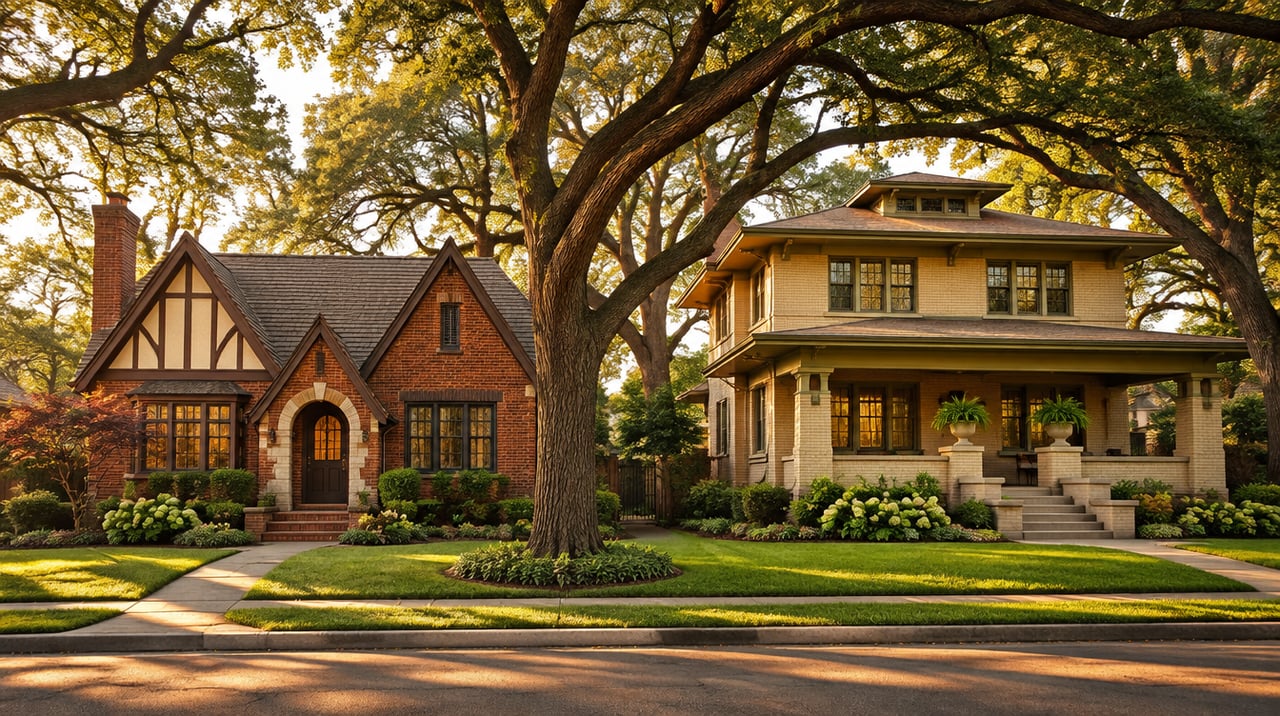
A conservation district protects the look of a neighborhood, and city planning staff check your plans against rules the neighbors wrote. A historic district protects the historic houses themselves, and most exterior changes need a Certificate of Appropriateness, with bigger projects going before the Dallas Landmark Commission. In East Dallas, which one a house sits in decides how freely you can renovate, add on or rebuild.
The Agency Dallas helps buyers and sellers across East Dallas sort out what a district designation means for a specific address before anyone signs a contract.
Why does this even matter? A short story about a porch
Picture it. A Saturday in October, a couple from Uptown wanders down a shady East Dallas street with iced coffees and a vague plan to "just look." They find it: a 1910s house with a porch so deep you could host a dinner party on it, original leaded glass, oak trees older than most of the city's skyline. They are in love by the second step. By Tuesday they have plans. New windows. A bigger second floor. Maybe a modern glass addition out back, and a black metal fence, because everyone on Instagram has one.
Then someone asks the question that changes the whole conversation: is this house in a historic district or a conservation district?
Those two words sound almost identical. They are not. One answer means the window plan is likely fine with a quick staff review. The other means the windows, the fence, the addition, and even some landscaping need written approval before a single contractor shows up. Nobody is trying to ruin anyone's weekend. These districts are a big reason East Dallas looks the way it does, and the reason so many people want to live there. But you want to know the rules before you fall in love, not after.
This guide explains both, in plain English, and walks through every major district in East Dallas.
How common are these districts in Dallas?
Less common than most people assume, which is part of why they carry a premium. According to Preserving Dallas 2025, a study PlaceEconomics completed for the City of Dallas in 2025:
- Dallas has 21 local historic districts and 19 conservation districts.
- Together they cover about 1.5% of the city's land area.
- In 2024, the average single-family home in a conservation district was valued about 79% above the rest of Dallas.
- The average single-family home in a historic district was valued about 15% above the rest of Dallas.
- Conservation districts were about 71% owner-occupied in 2020, compared with about 33% in historic districts and 41% in the rest of the city.
Those value numbers describe whole districts, not any one house, and they reflect location and lot size as much as the designation itself. Still, they tell you something real: buyers pay for neighborhoods with protected character, and a large share of East Dallas sits inside one of these districts.
What is a conservation district in Dallas?
A conservation district is a zoning tool that protects the overall character of a neighborhood: its scale, its setbacks, its architectural style. Dallas has used conservation districts since 1988. Creating one is a neighborhood-driven process that the City says usually takes 12 to 18 months from the start of the study to City Council adoption.
Here is what makes a conservation district different:
- The neighbors write the rules. Each conservation district has its own ordinance, drafted through a community process that the City coordinates. Two conservation districts can have very different rules.
- City staff do the review. When you plan exterior work, you file a Conservation District Work Review. Planning staff compare your plans to the district ordinance. There is no public hearing for a typical project.
- Style matters more than original materials. A conservation district usually cares that a new house or addition looks right for the street. Newer materials are often allowed if the design fits.
- Some work needs review even without a building permit. Fences, certain exterior changes and other visible work can require a Conservation District Work Review even when the building department would not require a permit.
A useful way to think about it: a conservation district protects the neighborhood's look. It does not usually require you to keep the original house exactly as it was.
What is a historic district in Dallas?
A historic district, which the City also calls a Landmark District, protects an area with a concentration of historic structures. The focus is the buildings themselves and the historic setting around them. The Dallas Landmark Commission, appointed by City Council, oversees these districts using preservation criteria written into each district's ordinance.
Here is what makes a historic district different:
- Almost all exterior work needs a Certificate of Appropriateness. The City requires a Certificate of Appropriateness, often shortened to CA, before exterior work begins on any property in a Landmark District. That includes work on the rear of a house, fences and gates, retaining walls, carports, and landscaping features over six inches tall.
- Small jobs go to staff. Big jobs go to the Commission. Minor repairs that do not change design, material or appearance are handled as Routine Maintenance at the staff level. The City says those reviews can take up to 21 days, though staff often finish sooner. Larger changes go to the full Landmark Commission.
- There is a monthly deadline. Applications for Landmark Commission review are due by noon on the fourth Monday of each month, and the City describes that deadline as firm.
- Original materials matter. Historic districts generally expect period-appropriate materials and repair over replacement, with some flexibility in less visible spots.
- Demolition is hard. Demolition requires a separate Certificate for Demolition, and contributing historic houses are rarely approved for removal.
- Approvals expire if work stalls. A CA lapses if continuous progress is not made for more than 180 days.
A useful way to think about it: a historic district protects the actual historic house. If you buy one, you are also signing up to be its caretaker.
Conservation district vs. historic district: the side-by-side
Question | Conservation district | Historic district |
|---|---|---|
What it protects | Neighborhood character and style | Historic structures and their setting |
Who writes the rules | Residents, through a City-coordinated ordinance | Preservation criteria in each district ordinance, overseen by the Landmark Commission |
Who approves changes | City planning staff | Staff for routine work; the Landmark Commission for larger changes |
Name of the approval | Conservation District Work Review | Certificate of Appropriateness |
Typical timeline | Usually shorter, depends on the project | Up to 21 days for routine staff review; longer for Commission review tied to a monthly deadline |
Materials | More flexible if the design fits | Period-appropriate materials generally expected |
Demolition | Varies by ordinance | Requires a Certificate for Demolition; rarely approved for contributing houses |
New construction | Allowed if it meets the ordinance, often including a required style | Allowed but must fit the district's preservation criteria |
Historic tax exemption | Not eligible under the City's historic program | Contributing structures may qualify |
What about Neighborhood Stabilization Overlays?
This is the third option most guides skip, and it causes plenty of confusion. Dallas City Council created the Neighborhood Stabilization Overlay, or NSO, in November 2005. An NSO is a lighter tool aimed at keeping new infill houses in scale with their neighbors.
- An NSO regulates a short list of things: front and side setbacks, building height through a height plane, and garage placement and access.
- It does not regulate architectural style, materials, colors or details.
- Building permit staff review NSO rules as part of the normal permit, so there is no separate design review.
- An NSO cannot be placed on a neighborhood that is already a conservation district or historic district.
The City describes the NSO as a way to keep a neighborhood's general built character without the administrative burden or architectural detail of a historic or conservation district. If someone tells you a street "has rules," it is worth asking which of the three tools they mean.
Which East Dallas neighborhoods are historic districts?
East Dallas holds several of the city's best-known historic districts. Each one has its own ordinance, map and preservation criteria, all published by the City of Dallas Office of Historic Preservation.
Swiss Avenue Historic District
Dallas's first historic district, designated in 1973 and listed on the National Register of Historic Places in 1974. It runs along Swiss Avenue between Fitzhugh and La Vista and is known for grand homes set behind landscaped parkways. Our full guide: What are the rules in the Swiss Avenue Historic District? For costs, see what it costs to live on Swiss Avenue.
Munger Place Historic District
A Dallas Landmark District since 1988, with more than 200 homes. The City describes it as the largest intact collection of Prairie-influenced structures in North Texas. Our full guide: What should buyers know about the Munger Place Historic District?
Junius Heights Historic District
Founded in 1906 as a streetcar neighborhood and designated a Dallas Landmark District in 2006. The City counts more than 800 residences in Craftsman, Prairie and Tudor styles, which makes it one of the largest historic districts in Dallas. Our full guide: What should buyers know about the Junius Heights Historic District?
Peak's Suburban Addition Historic District
Designated in 1995 as Dallas's fourteenth historic district, with one of the highest concentrations of Victorian homes in the city, along with Prairie homes and streetcar-era apartments. Our full guide: What should buyers know about Peak's Suburban Addition?
Which East Dallas neighborhoods are conservation districts?
Several of East Dallas's most popular neighborhoods are conservation districts rather than historic districts. The City publishes each ordinance and map on its Conservation Districts page.
- Lakewood: covers only part of Lakewood, not the whole neighborhood. See how the Lakewood Conservation District affects buying or renovating.
- M Streets (Greenland Hills) and M Streets East: two separate conservation districts known for Tudor cottages. See how the M Streets conservation districts affect buying or renovating and what to inspect in an older M Streets Tudor.
- Hollywood/Santa Monica: a conservation district known for its cottage architecture near White Rock.
- Belmont Addition: a conservation district near Lower Greenville.
- Vickery Place: a conservation district formed in 2006, with Tudor, Colonial Revival, Craftsman and Prairie homes.
One warning applies everywhere: a neighborhood name is not proof. District lines often cover only part of a neighborhood, and two houses on the same street can sit on different sides of a boundary. Always check the specific address against the City's district map.
How do I find out if a house is in a district?
- Check the City's maps. The City of Dallas publishes a map for each historic district through the Office of Historic Preservation and for each conservation district through Planning and Development.
- Read the ordinance. Each district's ordinance is public. Look for what it says about additions, height, windows, fences, garages, materials and demolition.
- Ask whether the house is "contributing." In a historic district, a contributing house is one that adds to the district's historic character. Contributing status affects how strictly changes are reviewed and whether the house may qualify for the City's historic tax exemption.
- Call the district planner. The City assigns staff to each district and encourages owners to talk with them before submitting plans. Major remodels and new construction in historic districts should be reviewed with the district's preservation planner before the submittal deadline.
- Ask the seller about past approvals. Request copies of any Certificates of Appropriateness or Conservation District Work Reviews for past work. Unapproved work can become the new owner's problem.
What should buyers check during the option period?
The Texas option period is short, so a district home deserves a focused checklist. Here is what we recommend buyers line up before the option period ends:
- Confirm the district, the ordinance and whether the house is contributing.
- Compare your renovation plans to the ordinance, especially additions, second stories, windows and fences.
- Ask for records of past approvals and look for exterior work that may not have been approved.
- Bring an inspector who understands older homes: original wiring, plumbing, foundations, wood windows and roofs. Our guide on what to know before buying a historic home covers the inspection in more detail.
- If a big project is the whole reason for the purchase, talk to a residential architect who has worked in that district.
- Budget time. A project that needs Landmark Commission approval follows the monthly calendar, so plan for that in your move-in timeline.
What should sellers in a district know before listing?
- Gather your paperwork. Approved CAs or work reviews, permits, and receipts for restoration work all help buyers feel confident.
- Disclose what you know. If exterior work was done without an approval, talk with your agent about how to handle it before you list.
- Sell the protection. Many buyers are specifically looking for the stability a district provides. The rules are part of the value, not just a hurdle.
- Know your tax status. If your house is in a historic district and received the City's historic tax exemption, buyers will want to know the details and the remaining term.
For a broader look at preparing a home for market, see our seller guide.
Is there a tax break for owning in a historic district?
Possibly. The City of Dallas offers tax exemptions to owners who complete qualifying rehabilitation work on historic properties. Only individually designated Dallas Landmarks and structures in Landmark Districts are eligible, which means conservation districts do not qualify under this program. The amount depends on the type of property and how much is invested in the rehabilitation, and owners must file the application with the Dallas Central Appraisal District each year they are eligible. The program is not a grant, and the rules are detailed, so it is worth reading the City's program materials before you count on it.
Do the rules really hurt resale?
The data points the other way. The City's own 2025 study found higher average values in both district types than in the rest of Dallas. Rules limit what any one owner can do, but they also limit what your neighbors can do. A buyer who pays a premium for a Prairie foursquare on a street of Prairie foursquares is buying the street as much as the house. That predictability is a big part of why East Dallas district homes hold their appeal.
If you are planning a purchase in this area, The Agency Dallas can walk you through what is on the market now; you can reach our team through our contact page.
Frequently asked questions
What is the main difference between a conservation district and a historic district in Dallas?
A conservation district protects a neighborhood's overall character and style, and City planning staff review exterior changes against rules the residents wrote. A historic district protects the historic structures themselves, requires a Certificate of Appropriateness for nearly all exterior work, and sends larger projects to the Dallas Landmark Commission. Historic districts are generally stricter about materials and demolition.
Do I need approval to replace windows in an East Dallas historic district?
Yes. In a Dallas historic district, exterior work requires a Certificate of Appropriateness before it begins. Repairs that keep the same design and materials may qualify as Routine Maintenance reviewed by City staff. Replacing original windows with a different design or material is a bigger change and may require Landmark Commission review. Check with the district's preservation planner before ordering anything.
Can I add a second story in an East Dallas conservation district?
It depends on the district's ordinance. Each Dallas conservation district sets its own rules on height, setbacks, rooflines and additions, and some are stricter than others. You file a Conservation District Work Review, and City staff compare your plans to the ordinance. Read the ordinance for that specific district before you buy if a second story is part of your plan.
How long does Landmark Commission approval take in Dallas?
Routine Maintenance reviewed by City staff can take up to 21 days, according to the City, and is often faster. Projects that need full Landmark Commission review follow a monthly cycle, with applications due by noon on the fourth Monday of each month. Larger projects should be discussed with the district's preservation planner before submittal, so build extra time into your schedule.
How do I know if a Dallas house is in a historic or conservation district?
Check the address against the City of Dallas district maps. Historic district maps and ordinances are published by the Office of Historic Preservation, and conservation district maps are published by Planning and Development. Do not rely on the neighborhood name, since district boundaries often cover only part of a neighborhood. City staff can confirm a property's status if you are unsure.
Do conservation district homes qualify for the Dallas historic tax exemption?
No. The City of Dallas historic tax exemption program applies to individually designated Dallas Landmarks and structures in Landmark Districts, which are the City's historic districts. Conservation districts are a zoning tool for neighborhood character and are not part of that program. In historic districts, the exemption depends on the property type and the amount invested in qualifying rehabilitation.
Sources: City of Dallas Office of Historic Preservation (Landmark Review Process, FAQ, tax incentive program); City of Dallas Planning and Development (Conservation Districts, Neighborhood Stabilization Overlay); PlaceEconomics, Preserving Dallas 2025, prepared for the City of Dallas; The Dallas Morning News, January 2025. District rules change; confirm current requirements with the City before starting any project.